liveBook · Manning

Metaflow

As explained in Designing Deep Learning Systems: A guide for software engineers

Metaflow is an open-source framework for building, executing, and managing data science and machine learning workflows.

Metaflow is an open-source, human-friendly Python framework for building and operating machine-learning workflows. It reduces the friction between prototype code and production execution by treating local and production environments as first-class targets. section 9.3.3

Metaflow organizes workflow development around practical production requirements:

  • Define a workflow as a Python class, using annotations to mark steps and construct a directed acyclic graph. section 9.3.3
  • Run the same workflow locally or through production schedulers without changing its implementation. section 9.3.3
  • Preserve reproducibility through workflow and step versioning plus saved step inputs and outputs. section 9.3.3
  • Delegate production execution to systems such as AWS Step Functions or Argo Workflows. section 9.3.3

A data-processing workflow

A Python workflow can fetch new data, transform it, fan out to database storage and team notification steps, and then join the branches. Developers can inspect the DAG with `python data_process_workflow.py show`, run it locally with `python data_process_workflow.py run`, or create AWS Step Functions and Argo Workflows deployments from the same code. section 9.3.3 section 9.3
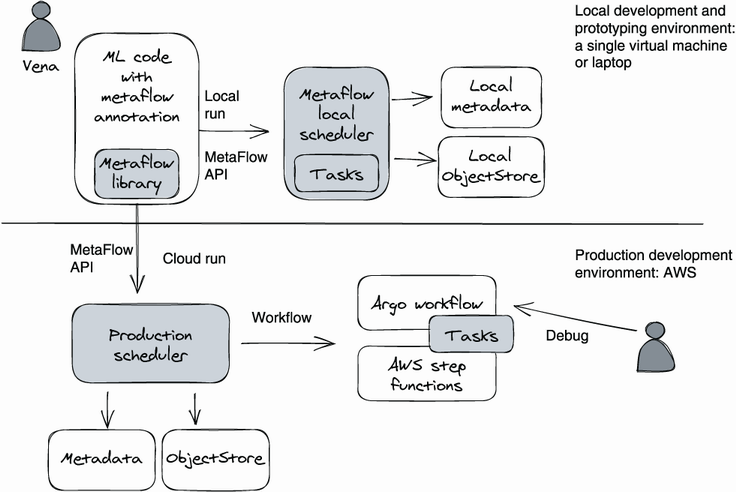
Figure 9.7 Metaflow offers a unified development experience between prototyping and production.

Use the architecture figure to compare Metaflow’s unified prototyping and production execution model. section 9.3.3

How Designing Deep Learning Systems: A guide for software engineers covers it

How deep it goes
Explains Python DAG construction, unified execution, reproducibility features, and deployment commands without detailing infrastructure internals.
Examples
Uses data fetching, transformation, database storage, team notification, branching, local execution, and scheduler deployment.
What it assumes
Assumes Python workflow code and introduces the transition from prototyping to production execution.
What you can do after
Build and run Python-defined machine-learning workflows locally, then deploy them to AWS Step Functions or Argo Workflows.
How it connects
Connects MLOps with workflow orchestration, directed acyclic graphs, reproducibility, AWS Step Functions, and Argo Workflows.

Related concepts

This explainer was generated by Manning's knowledge graph from the text of Designing Deep Learning Systems: A guide for software engineers. The section links point to the parts of the book it draws on.