A metaheuristic is a high-level strategy that guides or modifies heuristics to search efficiently for optimal or near-optimal solutions. It does not guarantee optimality, but aims to produce useful results within practical time limits. section 2.3 section 2.5
Metaheuristics manage the tension between exploration and exploitation: they search different regions of the solution space while intensifying effort around promising solutions. This helps avoid becoming trapped in a confined area. section 2.3
Common characteristics include:
- Global search across different problem instances and sizes, often with relatively few problem-specific modifications. section 2.3
- Support for linear and nonlinear optimization problems, including problems involving random variables. section 2.3
- Trade-offs against exact methods: search can be faster, but solutions may be suboptimal or lack optimality guarantees. section 2.3
Bin packing
Packing six objects of sizes 2, 4, 3, 6, 5, and 1 into bins of capacity 7 creates a large search space. Heuristic ordering can find feasible arrangements much faster than brute force, while a metaheuristic can guide and modify such search strategies to improve results. section 2.3
Figure 2.21 Repeated solution recombination—taking the first two elements of S1 and adding the last eight elements of S2 yields a new, better solution.
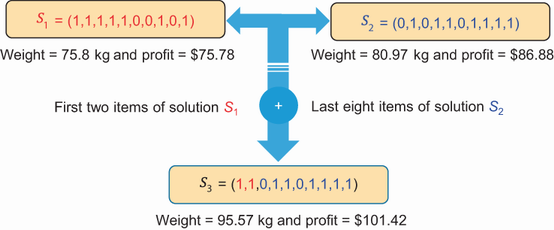
Use the recombination figure to inspect how parts of two candidate solutions can be combined into a new, better solution. section 2.3


