Mindset diversity brings people with different backgrounds and perspectives into a forecasting group so they draw on different information. Its value is not simply more participants: distinct inputs can reveal different insights, while differing biases are more likely to offset one another when forecasts are combined. section 16.4 section 16.3.1
Use it for a clear decision: how should a demand forecast be reviewed or edited? Assemble contributors whose perspectives and information differ, but make sure they share the goal of estimating unconstrained future demand rather than advancing a sales target, supply plan, or budget. Diversity cannot correct a bias that everyone has an incentive to introduce. section 16.3.1 section 17.0
Make mindset diversity effective alongside the other conditions for sound group judgment:
- Align objectives so no participant benefits from skewing the forecast in a particular direction. section 16.3.1
- Keep work and judgment independent before group discussion, limiting social pressure, anchoring, and groupthink. section 16.4
- Discuss assumptions and demand drivers rather than defending final forecast numbers. section 16.4
- Monitor forecast value added to determine whether the team’s review effort improves the forecast enough to justify its time. section 16.4
Reviewing a baseline forecast
Ask several team members to review a baseline demand forecast from different points of view and with diverse sources of information. Have each identify assumptions and likely impacts independently, then compare those assumptions. This preserves distinct insights better than beginning with a shared target number. section 17.0 section 16.4
Figure 16.5 Wisdom of the crowds’ three pillars
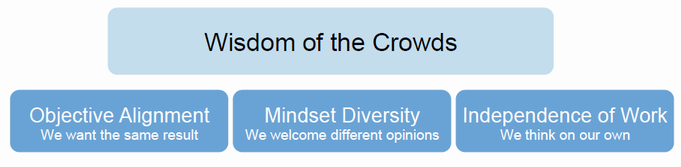
The three-pillar view places mindset diversity beside objective alignment and independence of judgment, showing why diversity alone is insufficient for crowd wisdom. section 16.3.1
