Wisdom of crowds improves predictions by aggregating different people’s judgments. Its accuracy depends on aligned objectives, diverse mindsets, and independent work and judgment. section 16.3.1
Check these conditions before treating an average judgment as reliable:
- Align objectives so participants make their best unbiased estimates rather than pursuing hidden interests. section 16.3.1
- Preserve mindset diversity and independence of work and judgment so individual biases can compensate rather than reinforce one another. section 16.3.1
Estimating cattle weight
In a cattle-weight competition, averaging many guesses produced a virtually perfect estimate and outperformed both the winning individual and the experts. In demand planning, a team whose members all favor high estimates will still produce an overly optimistic forecast. section 16.3.1
Figure 16.5 Wisdom of the crowds’ three pillars
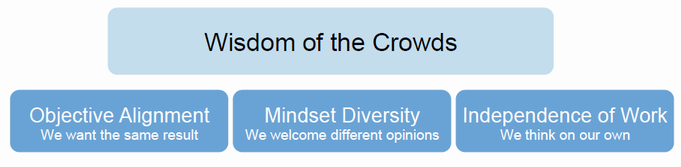
Use the figure to inspect the three conditions required for collective forecasting accuracy. section 16.3.1
