Independence of work and judgment means forming assessments separately before group influence shapes them. In demand planning, it protects contributors from social pressure, anchoring bias, and groupthink, preserving the distinct information each person brings to a forecast. section 16.4
It is one condition for wisdom of the crowds: averaging judgments can improve a prediction, but only when contributors are not pulled toward the same answer. Independence works alongside aligned objectives and diverse mindsets; otherwise shared incentives or shared biases can still produce a biased forecast. section 16.3.1 section 16.4
Figure 16.5 Wisdom of the crowds’ three pillars
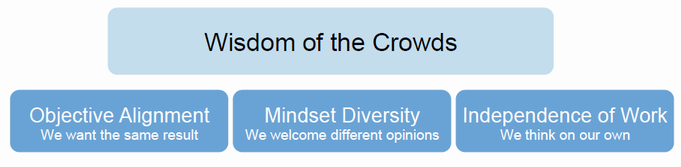
Use the three-pillar view to check whether a forecasting group has the conditions needed for collective judgment to add value. section 16.3.1
Structure a forecast review so independent judgment survives long enough to be useful:
- Clarify that the forecast is an unconstrained, unbiased prediction of demand—not a supply plan, sales target, or budget—so contributors have less reason to skew it. section 16.3.1
- Ask participants to review the baseline forecast independently, drawing on their own perspectives and information sources. section 16.4 section 17.0
- Discuss underlying assumptions and demand drivers rather than arguing over final numbers. section 16.4 section 17.0
- Monitor forecast value added to hold the process accountable for the value of team effort. section 16.4
A demand-planning review
Before a meeting, sales, operations, and other reviewers each assess a baseline demand forecast on their own. The meeting then compares the assumptions behind their views—such as expected demand drivers and impacts—rather than letting the first stated number become the group’s anchor. section 16.4 section 17.0
Figure 16.6 Groupthink illustrated by Jono Hey on his website sketchplanations.com
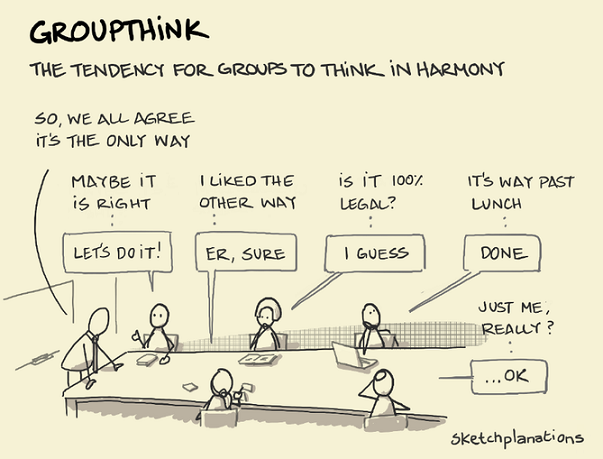
Use the groupthink illustration as a reminder that apparent agreement may reflect conformity rather than independent evidence. section 16.4
