Groupthink occurs when the desire for harmony and consensus suppresses independent judgment. In demand forecasting, it can amplify other biases and weaken the final forecast. section 16.3.1 section 16.4
Reduce groupthink during collaborative forecasting by:
- Gathering people with different backgrounds, mindsets, and quantitative or qualitative perspectives. section 16.3.1
- Having each participant develop a forecast independently before sharing it with the group. section 16.3.1
- Removing social, hierarchical, political, and peer pressure so dissenting predictions feel safe. section 16.3.1
- Discussing assumptions and demand drivers rather than immediately debating final numbers. section 16.4
- Using anonymous predictions when meetings still create excessive influence or conformity. section 16.3.1
An independent S&OP forecast
Before a critical S&OP meeting, participants privately record the sales numbers they expect. The group then compares the underlying assumptions, rather than allowing an early opinion or hierarchy to anchor everyone else. section 16.3.1 section 16.4
Figure 16.6 Groupthink illustrated by Jono Hey on his website sketchplanations.com
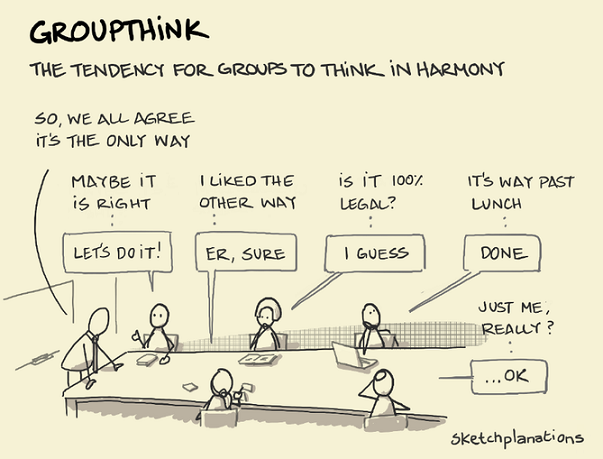
Use the illustration to recognize how conformity can displace independent judgment in group forecasting. section 16.3.1
