Social rank is a person’s relative position in a group’s social hierarchy. It shapes whose knowledge, confidence, and perspective seem credible, influencing who speaks, waits, leads, or stays quiet. Rank is subjective and context-dependent: the same person can be low-ranked in one setting and high-ranked in another. section 6.0 section 6.1.1
Explicit rank comes from formal position, such as a job title, organizational level, or authority. Implicit rank comes from socially supported, often unearned characteristics and perceptions, including gender, age, ethnicity, education, knowledge, experience, status, and charisma. Group membership can also confer rank. section 6.1.2 section 6.2.1
Rank is not inherently harmful. It can provide orientation and make leadership legible in an unfamiliar group. Problems arise when higher-ranked people dominate or when lower-ranked people cannot be heard: information flow narrows, psychological safety drops, and collaborative design may produce shallow models, excessive complexity, or messy architecture. section 6.3.2 section 6.7
When expertise narrows discovery
A long-serving developer seen as a technical genius may become the group’s default leader. Their knowledge helps, but discussion can become anchored in the existing system’s constraints, leaving domain experts less able to contribute and restricting exploration of the domain. section 6.2.2
Facilitate rank without pretending it is absent:
- Learn the power dynamics and symbols of power before inviting stakeholders; use interviews and reflective field notes to examine assumptions. section 6.5
- Use a respected, explicitly high-ranked person to introduce the facilitator, then establish clear safety rules and personally welcome participants. section 6.3.1 section 6.5
- Delay high-ranked opinions when completeness matters so others can contribute before a view becomes dominant. section 6.4
- Run a sensemaking exercise after check-in: let people place themselves on a line, invite perspectives from different positions, and use the results to test the shared problem and goal. section 6.3.3
- Split groups across positions on the line after discussing rank, rather than allowing existing hierarchies to determine participation. section 6.5
Figure 6.1 Outcome of a ranking sensemaking exercise at BigScreen. The assessment is from Mindell (Source: Jam Cultures by Jitske Kramer [Management Impact, 2021]). It guides individuals to score themselves on factors such as heritage, gender, health, and education. Participants rank themselves relative to their peers and place their total score on a scale. From here, we can create subgroups from both sides of the scale and better understand the effect ranking has on the group.
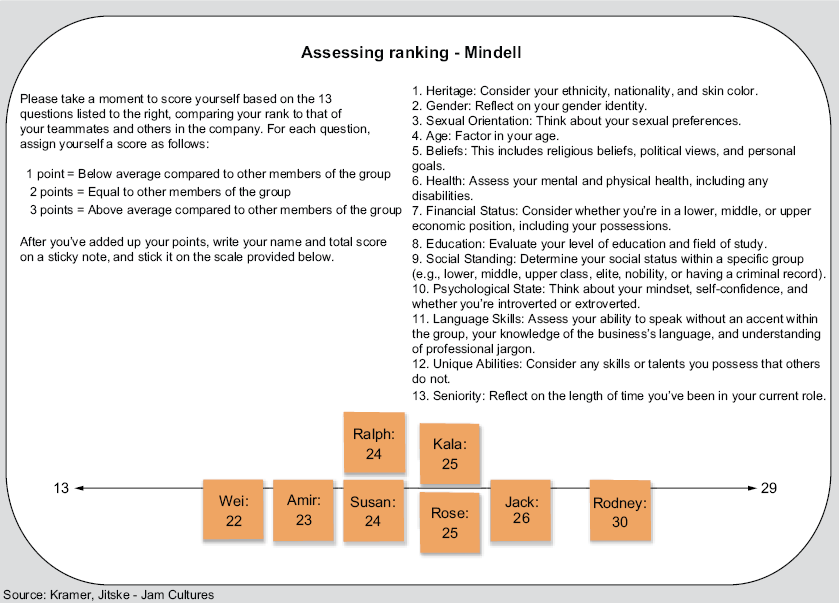
A self-assessment map makes relative rank discussable by having participants score factors and locate themselves on a shared scale. section 6.1.2
Treat rank conversations as sensitive. Higher-ranked participants may not notice their advantages, while lower-ranked participants can experience symbolic violence. Offer observations neutrally, use participants’ own words, and let the group decide whether a pattern is dysfunctional rather than imposing a diagnosis. section 6.3 section 8.3.2
