A social hierarchy orders people by relative status, influence, or authority. In collaborative modeling, that position is called ranking: a subjective, context-dependent sense of where someone stands relative to others. It shapes who speaks, waits, leads, or holds back, so it can quietly shape design decisions as much as technical expertise does. section 6.0 section 6.1.1
Ranking includes explicit and implicit forms. Explicit ranking comes from visible formal power, such as an organizational role, job title, or place in a hierarchy. Implicit ranking comes from socially supported or unearned advantages and perceived qualities, including gender, age, ethnicity, education, knowledge, experience, or charisma. Neither form is fixed: the same person can carry very different rank in different groups and situations. section 6.1.2 section 6.7
Power is also communicated symbolically. Prestige, authority, appearance, occupation, and other recognized traits can signal relative power, depending on the observer and culture. Symbolic violence names the nonphysical harm that can arise when such power differences sustain inequality or constrain participation. Naming these dynamics matters because highly ranked participants may dominate a session while lower-ranked participants struggle to be heard. section 6.1.3 section 6.7
Use ranking awareness to facilitate discovery rather than let hierarchy decide it:
- Before the session, map likely power dynamics among the invited stakeholders and clarify the facilitator’s explicit leadership role. section 6.7
- Explain ranking and its possible behavioral effects before asking people to discuss their own experiences or positions. section 6.1.2
- Invite reflection without forcing disclosure; acknowledging rank can be vulnerable, especially around implicit differences. section 6.1.2 section 6.7
- Create sensemaking activities that make divisions visible, then use the results to understand how the group’s dynamics affect collaboration. section 6.7
A ranking sensemaking exercise
Ask participants to assess themselves relative to peers across factors such as heritage, gender, health, and education, then place their total on a shared scale. Form subgroups from different sides of the scale and explore how rank may affect participation, influence, and the group’s work. Handle the activity carefully: its purpose is shared understanding, not an objective score or a label for anyone. section 6.1.2 section 6.7
Unchecked hierarchy can produce overly complex designs, shallow models, and messy software architecture. It can also leave lower-ranked teams under pressure to deliver and maintain systems without adequate resources. Treating rank as a collaborative condition—not an individual flaw—creates room to surface perspectives that would otherwise be excluded from the model. section 6.7
Figure 6.1 Outcome of a ranking sensemaking exercise at BigScreen. The assessment is from Mindell (Source: Jam Cultures by Jitske Kramer [Management Impact, 2021]). It guides individuals to score themselves on factors such as heritage, gender, health, and education. Participants rank themselves relative to their peers and place their total score on a scale. From here, we can create subgroups from both sides of the scale and better understand the effect ranking has on the group.
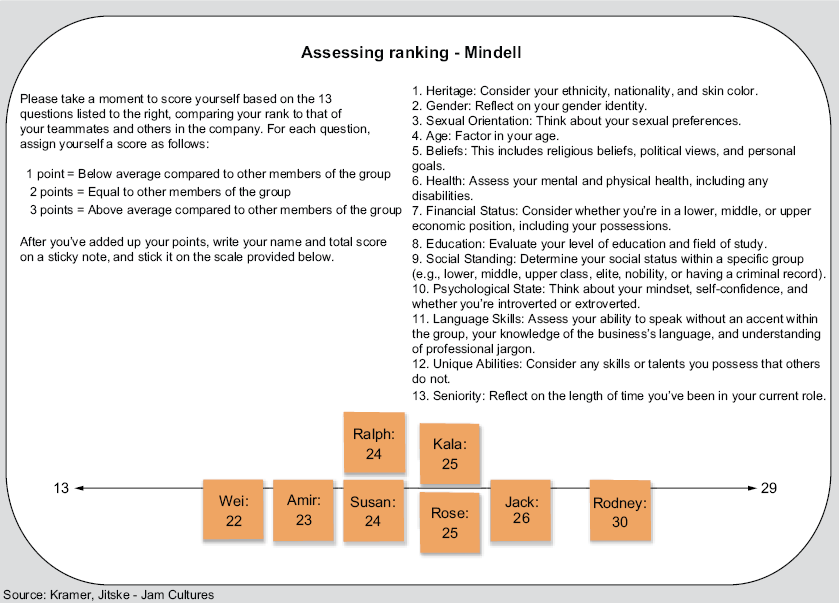
Use the plotted self-assessment as a prompt for discussing relative rank and forming subgroups that can examine its effect on the group. section 6.1.2
