A sensemaking task is a low-key, nonjudgmental group exercise for testing an observed assumption about what is happening beneath the visible work. It turns beliefs, worries, emotions, conflicts, and polarities into information the group can examine together, aiming for a shared sense of reality rather than a right answer. section 4.3.3 section 4.10
Use one when discussion cycles, progress slows, people avoid a topic, or some participants seem unable to speak up. The task makes group shadows explicit without claiming the facilitator’s interpretation is correct; the group supplies the data that confirms, changes, or dismisses the initial hunch. section 4.3 section 4.3.4
Run a sensemaking task as a short facilitation loop:
- Notice a pattern, tension, disagreement, or weak signal, and form a tentative mental model of it. section 4.3.3 section 5.4.2
- Pose a neutral question that lets the group locate its perspectives, such as placing dots or themselves along a line between two poles. section 4.3.2 section 4.3.3
- Make the distribution visible, then ask what stands out, who relates, and who sees it differently. section 5.6 section 5.4.2
- Guide a conversation with objective questions, observations, summaries, and more listening than talking. section 5.4.2
- Let the group decide the next process step, agreement, or follow-up rather than forcing a conclusion. section 4.3.4 section 4.3.2
Surfacing a product-delivery polarity
When a software-delivery discussion repeatedly returned to an unspoken issue, participants answered: “Do we build a standard product or custom-made solutions?” They placed dots along the two poles. The visible split opened a difficult conversation about beliefs that had shaped earlier friction, making it possible to address them together. section 4.3.3
The exercise can happen at any point in a session. Check-ins and check-outs are timed forms focused on participants; a midpoint confidence rating can reveal whether to adapt the session, while an end rating can inform the next one. In person, physical movement and ordering may reveal additional signals; online, dot placement and participation patterns remain useful. section 4.3.2 section 4.7 section 4.3.5
Sensemaking may create discomfort, vulnerability, or negative feedback because it brings delicate matters into view. Prepare by asking about conflicts, tensions, hierarchy, and hidden agendas, but stay ready to adapt: one task can expose further issues. A facilitator without a stake in the content helps maintain a safe process and prevents a visible result from becoming a premature judgment. section 4.3.4 section 5.4.4 section 5.4
Figure 4.9 Sensemaking exercise example on what product we’re actually building
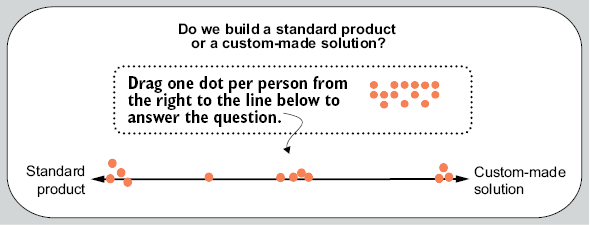
A polarity line shows how individual placements can make a previously unspoken divide discussable without reducing it to a facilitator’s verdict. section 4.3.3
