Objective alignment is the condition in which everyone contributing to a forecast is motivated to estimate demand as accurately and impartially as possible, rather than to steer the number toward a preferred outcome. It is one of the conditions needed for the wisdom of crowds: combining judgments helps only when shared incentives do not create the same directional bias in every contribution. section 16.3.1
A forecast serves a different purpose from a supply plan, sales target, or budget. It is an unconstrained, unbiased prediction of future demand. Confusing these roles creates pressure to alter the prediction for operational or performance reasons, even when the underlying demand estimate has not changed. section 16.3.1
When averaging does not remove bias
Suppose several colleagues all benefit from high estimates of future demand. Averaging their forecasts will not reliably improve accuracy, because their biases point in the same direction. The combined forecast can remain overly optimistic; more contributors do not help when they are all playing the same hidden game. section 16.3.1
Use objective alignment to protect judgmental demand forecasts from intentional distortion:
- State clearly that the task is to estimate future demand, not to negotiate a target, budget, or supply commitment. section 16.3.1
- Align KPIs and objectives so contributors gain nothing from moving the forecast up or down. section 16.3.1
- Avoid rewarding salespeople merely for beating the forecast, since that can encourage underforecasting to make targets easier to exceed. section 16.3.1
- Track achieved accuracy and bias through forecast value added (FVA) to reinforce accountability and ownership. section 16.3.1 section 16.4
Objective alignment is necessary but not sufficient for useful group judgment. Better demand-planning discussions also combine people with different mindsets, preserve independence of work and judgment, and focus discussion on assumptions and demand drivers rather than on final numbers. These practices reduce the chance that a single interest, social pressure, or shared viewpoint dominates the forecast. section 16.4
Figure 16.5 Wisdom of the crowds’ three pillars
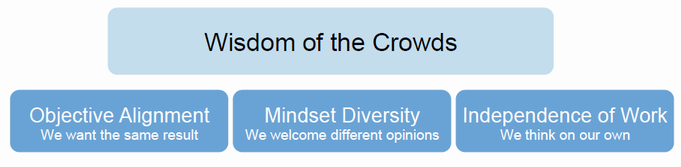
Inspect the three pillars that make crowd judgment more likely to improve a forecast: aligned objectives, mindset diversity, and independent work and judgment. section 16.3.1
