MLC LLM is an open-source ML compiler and high-performance deployment engine for serving language models across platforms, including mobile and edge devices. Its MLCEngine provides one runtime behind OpenAI-compatible interfaces for REST, Python, JavaScript, iOS, and Android applications. section 11.3
An MLC LLM deployment follows a model-to-runtime pipeline:
- Obtain model weights and configuration files from the Hugging Face Hub, then convert the weights into MLC format with a chosen quantization setting and target device. section 11.3
- Generate the chat configuration, compile a platform-specific model library, and load both the converted model and library into MLCEngine. section 11.3
- Run completions through the OpenAI-style API or expose the model through an MLC LLM REST server. section 11.3
- Use batching, prompt caching, concurrency, and platform-specific compilation to address serving performance and deployment constraints. section 11.3
Converting and serving RedPajama
A Linux deployment can convert RedPajama INCITE Instruct 3B with q4f16_1 quantization for CUDA, generate its redpajama_chat configuration, compile a CUDA model library, and load it with MLCEngine. The same converted model can serve streamed chat completions at an OpenAI-compatible REST endpoint. section 11.3 section 11.5
Figure 11.3 The end-to-end workflow for MLC LLM, from model conversion to deployment on the supported platforms’ native runtimes
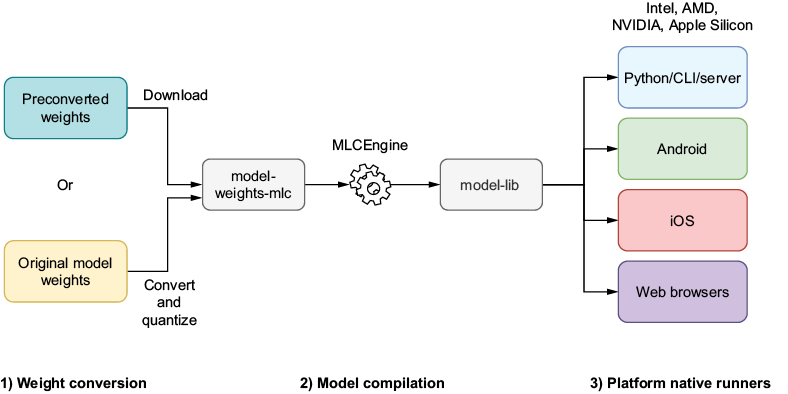
The end-to-end workflow diagram connects model conversion, compilation, the unified engine, and deployment on native platform runtimes. section 11.3
