Torch.compile()
torch.compile() is a PyTorch API that compiles and optimizes functions or modules for execution.

Deep Learning with PyTorch, Second Edition
- How it is used
- Optimizes PyTorch model execution for faster inference and production deployment with minimal code changes.
- How deep it goes
- Explains kernel fusion, operator reordering, and graph breaks, including their performance tradeoffs.
- Examples
- Wraps a pretrained causal language model and contrasts compilation with export for a model using an input-dependent conditional.
- What you can do after
- Apply it via torch.compile to an existing model and assess performance on the intended workload.
Read how Deep Learning with PyTorch, Second Edition explains torch.compile() →
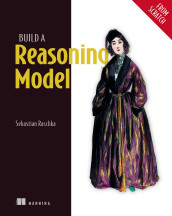
Build a Reasoning Model (From Scratch)
An optimization process that transforms a model's computation graph into more efficient executable code for faster inference.
- How it is used
- Speeds repeated autoregressive text-generation calls, especially during larger evaluations and reasoning workflows.
- How deep it goes
- Explains graph optimization, compilation overhead, benchmarking, configuration, and hardware results without detailing compiler internals.
- Examples
- Demonstrates torch.compile, repeated warm-up and timed runs, KV-cache generation, and token-per-second comparisons across Mac Mini M4 and NVIDIA H100 hardware.
- What you can do after
- Apply it via PyTorch's torch.compile and diagnose speed gains by separating warm-up overhead from timed generation.
Read how Build a Reasoning Model (From Scratch) explains torch.compile() →

Deep Learning with R, Third Edition
torch.compile is a PyTorch utility that transforms functions or module instances into compiled versions intended to execute faster.
- How it is used
- Speeds PyTorch functions or modules when eager execution is insufficient and compilation works for the model.
- How deep it goes
- Defines Module, function, and decorator usage, then stops short of compiler internals and warns about compatibility and speed variability.
- Examples
- Uses a compiled linear-classifier Module and a compiled dense function with matrix multiplication and ReLU.
- What you can do after
- Apply it via torch.compile() to PyTorch functions or modules, then check whether execution actually becomes faster.
Read how Deep Learning with R, Third Edition explains torch.compile() →
Also covered in
- Deep Learning with Python, Third Edition
- GPU Programming with TritonIn early access (MEAP)
- CUDA for LLMs
What to know first
- CUDACUDA is NVIDIA’s parallel computing platform and programming model for performing general-purpose computations on NVIDIA GPUs.
- optimizationOptimization is the systematic selection or modification of values, configurations, or implementations to improve a defined objective, often subject to constraints.
- PythonPython is a high-level, general-purpose, dynamically typed programming language with readable syntax and support for multiple programming paradigms.
- computation graphA computation graph is a directed graph whose nodes represent computational operations or values and whose edges represent dependencies between them.
Related concepts
- PyTorch Dynamo compileruses · PyTorch Dynamo is a PyTorch component that analyzes Python execution to capture PyTorch operations in graphs for compilation and optimization.
- PyTorchpart of · PyTorch is an open-source machine-learning framework that provides tensor computation, automatic differentiation, and tools for developing and training neural networks.
- computation graphuses · A computation graph is a directed graph whose nodes represent computational operations or values and whose edges represent dependencies between them.
- just-in-time compilationuses · Just-in-time compilation is the translation or optimization of program code into executable form during program execution.
- torch.exportcontrasts with · torch.export is a PyTorch API that captures a model as a graph representation for analysis, transformation, and deployment.
Questions about torch.compile()
What is torch.compile()?
torch.compile() is a PyTorch API that compiles and optimizes functions or modules for execution.
Which Manning books explain torch.compile()?
Deep Learning with PyTorch, Second Edition, Build a Reasoning Model (From Scratch) and Deep Learning with R, Third Edition.
What should I know before learning torch.compile()?
Manning books that teach torch.compile() usually introduce CUDA, optimization, Python and computation graph first.
What is the difference between torch.compile() and torch.export?
torch.compile() is a PyTorch API that compiles and optimizes functions or modules for execution. torch.export is a PyTorch API that captures a model as a graph representation for analysis, transformation, and deployment.
What is torch.compile() part of?
Torch.compile() is part of PyTorch. PyTorch is an open-source machine-learning framework that provides tensor computation, automatic differentiation, and tools for developing and training neural networks.
These guides are generated from the text of Manning books by Manning's knowledge graph and link to the sections they draw on. The full books are available on liveBook and at manning.com.