Model development is an organized sequence that turns a measurable business problem and usable data into a tested model ready for deployment. It connects problem definition, data work, exploratory analysis, iterative modeling, stakeholder approval, deployment, documentation, and maintenance. section 1.4 section 11.1
A practical development process includes:
- Define a clear, measurable business problem and its success criteria. section 1.4 section 11.19
- Discover relevant, accessible, complete data and assess feasibility. section 11.1 section 11.19
- Clean and prepare data by addressing missing values, duplicates, categorical variables, outliers, and junk values. section 1.4 section 11.19
- Use exploratory analysis to identify patterns, relationships, and insights that can guide course correction. section 1.4 section 11.19
- Test candidate algorithms and hyperparameters, compare performance, obtain business approval, and prepare the selected model for deployment and maintenance. section 11.10 section 11.1
From candidate models to approval
A development team creates an initial model, iterates with different algorithms and hyperparameters, compares accuracy-related measures, and presents a statistically significant, useful model to business stakeholders for final feedback. Further iterations may follow before deployment. section 11.10
Table 1.2 Examples of how to define a business problem to make it clear, concise, and measurable
|
Examples
|
|
|---|---|
|
Ill-defined business problems
|
Good business problems
|
|
Increase the production
Decrease the cost |
Optimize the various cost heads (A, B, C, and D) and identify the most optimal combination to decrease the cost by 1.2% in the next six months
|
|
Increase the revenue by 80% in one month
Automate the entire process |
From the various factors of defects in the process (X, Y, Z), identify the most significant factors to reduce the defect % by 1.8% in the next three months
|
Use measurable business-problem examples to turn vague goals into bounded targets with explicit improvement percentages and timeframes. section 1.4
Figure 11.1 The complete machine learning modeling process
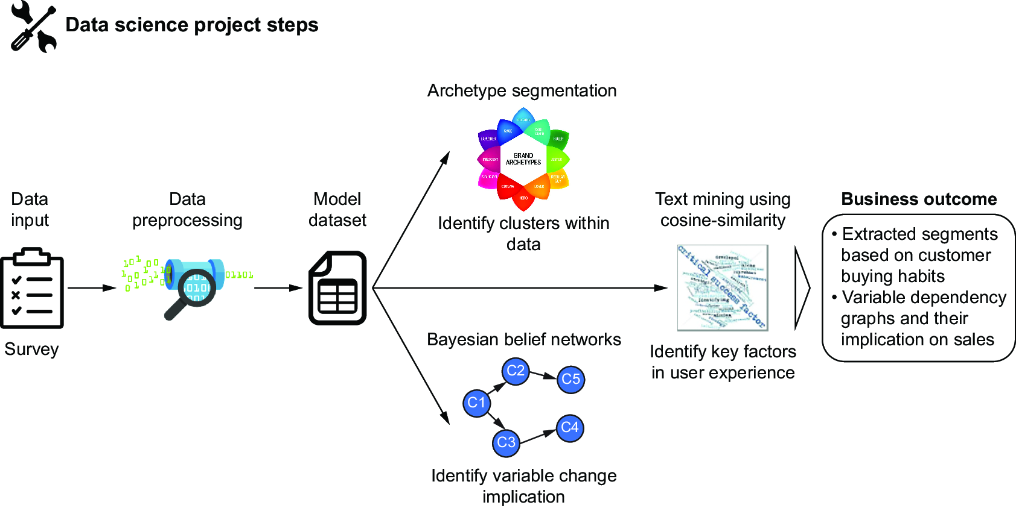
Follow the complete process from business problem definition through data work, modeling, deployment, documentation, and maintenance. section 11.1