A data flow diagram models how data moves through a specific application function. In testing, it exposes the handling steps that can be translated into focused prompts for identifying risks. section 5.3.1
A booking-list flow can represent these stages:
- An administrator requests a list of bookings and attaches a session token. section 5.3.1
- The system extracts the token and validates it against valid sessions. section 5.3.1
- A valid session produces a positive response, after which bookings are collated and returned. section 5.3.1
Turning the model into a testing prompt
A prompt can ask an LLM to generate risks for an application using session-based tokens to authorize access to booking lists. Candidate risks include predictable token generation, token leakage, unsafe storage, and session hijacking; each output still requires tester verification. section 5.3.1
The diagram clarifies data handling but omits other perspectives. Combining it with component, sequence, or use case diagrams can reveal architectural and user-flow risks that a single data flow view misses. section 5.3.2
Figure 5.4 A visual model of an application
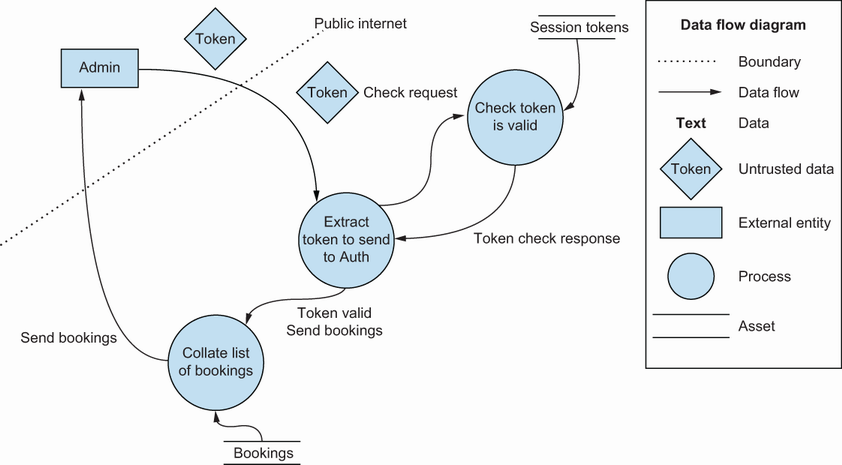
Use the visual model to trace the booking-list request, token validation, and returned data. section 5.3.1
