liveBook · Manning

Model focus

As explained in Designing Deep Learning Systems: A guide for software engineers

A metadata-system design approach that organizes and correlates metadata primarily around model files.

Model focus organizes and correlates metadata primarily around model files, helping users trace each model to its training run, inputs, metrics, stages, and artifacts. section 8.3.2

A model-focused metadata system can provide:

  • Links from model files to a shared training_run_id, connecting outputs with training data and metrics. section 8.3.2
  • Artifact discovery through URLs stored as training-run outputs, including models preserved across test, preproduction, and production stages. section 8.3.2
  • A search experience that supports both model-oriented and pipeline-oriented queries, even when storage uses pipeline focus. section 8.3.2
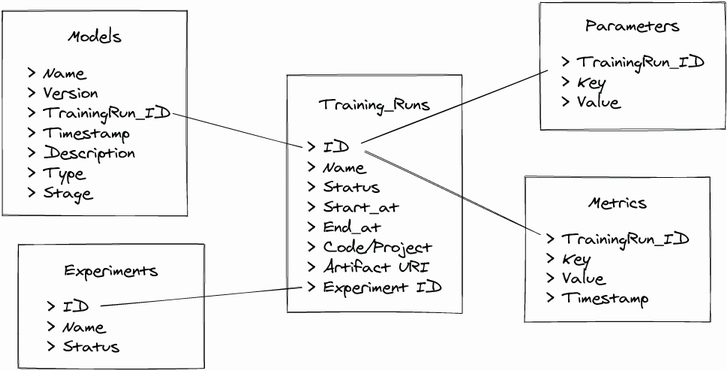
Figure 8.5 An entity relationship diagram of the data schema of the metadata storage

Use the schema diagram to inspect how model files, training runs, inputs, metrics, stages, and artifact URLs are connected. section 8.3.2

How Designing Deep Learning Systems: A guide for software engineers covers it

How deep it goes
Defines model focus and contrasts it with pipeline focus, while deferring detailed implementation to a combined storage and search design.
Examples
Uses model files, training runs, artifact URLs, training metrics, input data, and test-to-production stages as connected entities.
What you can do after
Evaluate metadata architectures by comparing model-centered correlation with pipeline-centered aggregation and supporting both through search.
How it connects
Connects model files with metadata stores, artifact stores, training runs, training data, metrics, and pipeline search.

Related concepts

This explainer was generated by Manning's knowledge graph from the text of Designing Deep Learning Systems: A guide for software engineers. The section links point to the parts of the book it draws on.