A model-free method learns favorable actions through trial-and-error interactions with an environment, without first building an explicit model of how that environment works. section 10.9
Unlike model-based learning, which simulates possible outcomes using an internal representation, a model-free agent explores interactions and learns which actions work in different situations. section 10.9
A Q-learning implementation makes the method concrete:
- Represent each state as a row and each possible action as a column in a Q-table. section 10.6
- Store a quality score, or Q-value, for every state-action combination rather than storing only one chosen action. section 10.6
- Move through the environment, receive rewards, observe the next state, and update estimates from the outcome. section 10.6
- Balance exploration and exploitation by sometimes choosing a random action and otherwise selecting the action with the highest current score. section 10.6
Finding a route
Imagine an agent moving through a road or grid environment toward a goal. Its initial Q-values are guesses; after repeated moves and reward updates, the largest value in each state’s row points toward a favorable action. section 10.9 section 10.6
Figure 10.19 Examples of model-based and model-free reinforcement learning
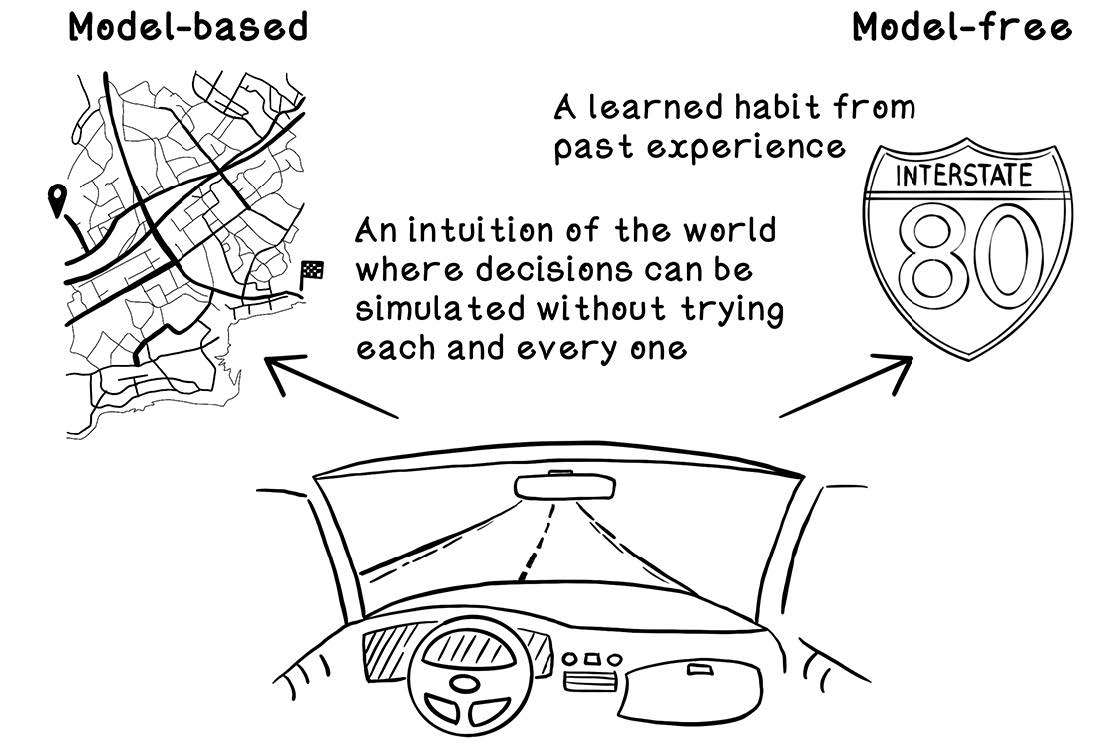
Compare model-based route planning with model-free learning through a visual road-navigation example. section 10.9

