A model-free method learns a policy or value function directly from interaction experience, without explicitly constructing the environment’s transition dynamics. It selects actions from observed histories and received rewards, improving through trial and error rather than planning with a learned environment model. section 12.1.3
Use these distinctions to position a model-free method:
- Treat the environment model as unnecessary for learning; rewards may be unknown or only partially known. section 12.1.3
- Separate on-policy and off-policy methods by the experience used: the current policy generates on-policy data, while another policy generates off-policy data. section 12.1.3
- Apply the approach to routing, ride-sharing dispatch, freight delivery, taxi dispatch, and traffic signal control. section 12.2
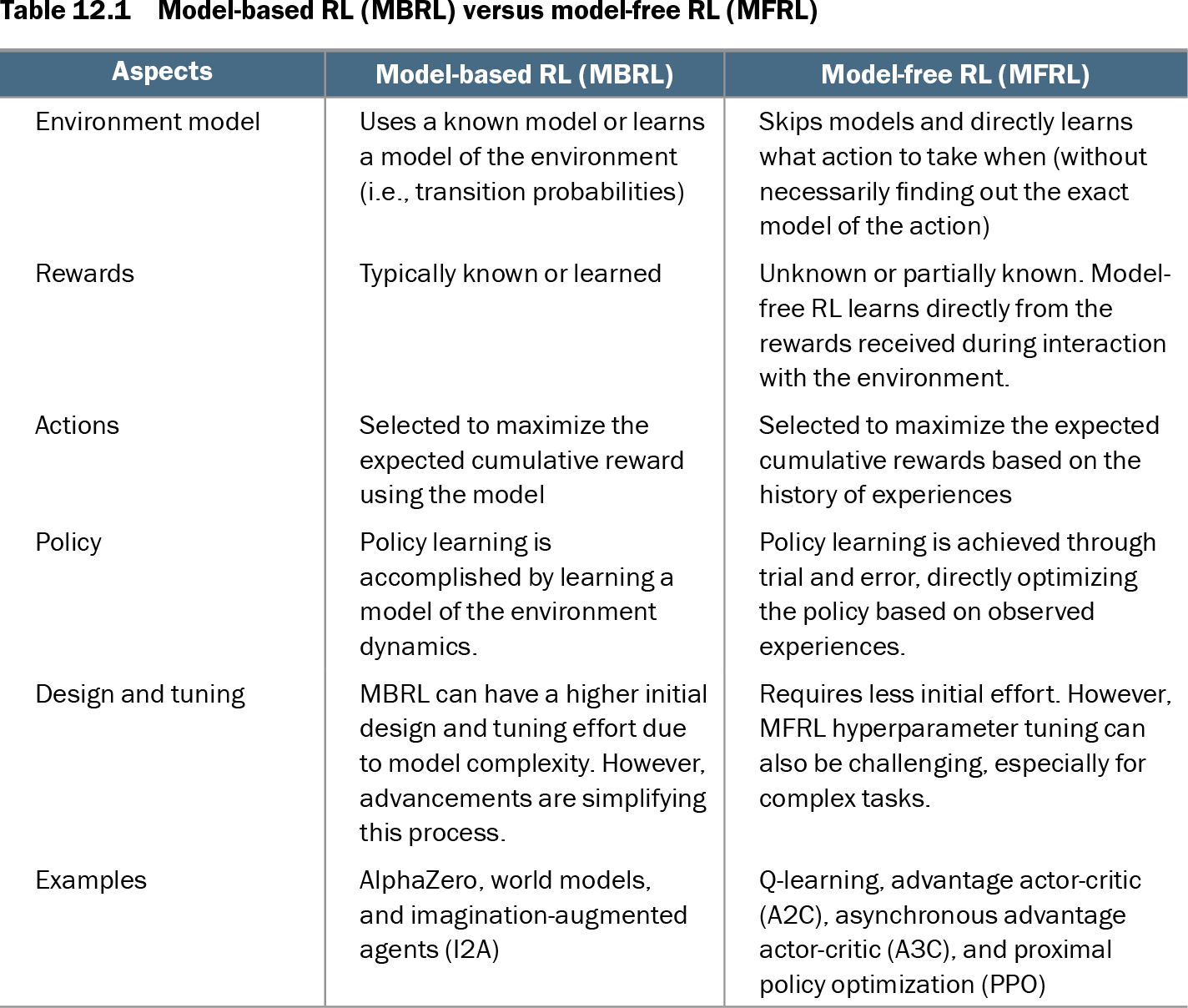
Table 12.1 Model-based RL (MBRL) versus model-free RL (MFRL) (view table figure)
| Aspects |
Model-based RL (MBRL) |
Model-free RL (MFRL) |
|---|---|---|
| Environment model |
Uses a known model or learns a model of the environment (i.e., transition probabilities) |
Skips models and directly learns what action to take when (without necessarily finding out the exact model of the action) |
| Rewards |
Typically known or learned |
Unknown or partially known. Model-free RL learns directly from the rewards received during interaction with the environment. |
| Actions |
Selected to maximize the expected cumulative reward using the model |
Selected to maximize the expected cumulative rewards based on the history of experiences |
| Policy |
Policy learning is accomplished by learning a model of the environment dynamics. |
Policy learning is achieved through trial and error, directly optimizing the policy based on observed experiences. |
| Design and tuning |
MBRL can have a higher initial design and tuning effort due to model complexity. However, advancements are simplifying this process. |
Requires less initial effort. However, MFRL hyperparameter tuning can also be challenging, especially for complex tasks. |
| Examples |
AlphaZero, world models, and imagination-augmented agents (I2A) |
Q-learning, advantage actor-critic (A2C), asynchronous advantage actor-critic (A3C), and proximal policy optimization (PPO) |
Compare model-free and model-based reinforcement learning by model use, rewards, action selection, and policy learning. section 12.1.3