liveBook · Manning

Model management

As explained in Delivering Machine Learning Projects: From design to deployment

Model management is the discipline of organizing, tracking, evaluating, and governing machine learning models throughout their development and deployment lifecycles.

Model management organizes machine learning models and their supporting artifacts so development remains iterative, controlled, accountable, and deployable. It connects experimentation with evaluation, qualification, deployment, and later investigation. section 5.5

A workable model-management system should:

  • Commission a model repository and record every artifact used in machine learning pipelines. section 5.5
  • Assign each model an identity linked to its binary or declarative specification for testing and production. section 5.5
  • Track data, features, hyperparameters, algorithms, architectures, evaluation metrics, test results, and pipeline identities for every iteration. section 5.5
  • Preserve model evolution and decision evidence to support investigations of stability, failures, blind spots, and governance. section 5.5
Figure 1.2 Drivers of complexity in an ML project: the domain, the data, and the models
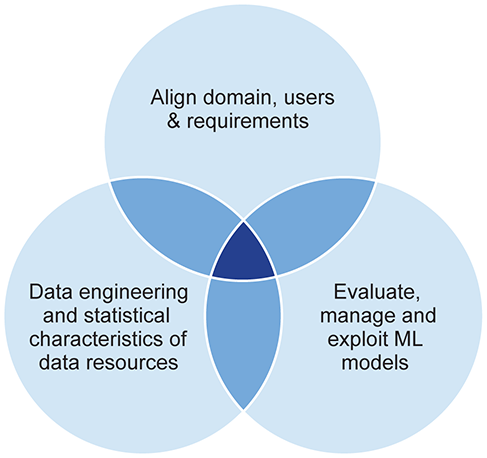
Use the domain, data, and models as a complexity frame when deciding what model-management records and controls are necessary. section 1.2

How Delivering Machine Learning Projects: From design to deployment covers it

How deep it goes
Specifies repository contents and accountability rationale, but stops short of prescribing a particular repository technology.
Examples
Uses ticket S1.4 and records model identities, parameters, artifacts, pipeline status, evaluation results, and qualification tests.
What it assumes
Assumes familiarity with machine learning models and pipelines while emphasizing controlled delivery and accountability.
What you can do after
Operate a repository that compares model iterations and supports evidence-based selection, deployment, monitoring, and failure investigation.
How it connects
Connects model versioning with data pipelines, evaluation metrics, testing, monitoring, deployment, and governance.

Related concepts

This explainer was generated by Manning's knowledge graph from the text of Delivering Machine Learning Projects: From design to deployment. The section links point to the parts of the book it draws on.