A model registry is a shared home for trained models: it stores model artifacts, links them to metadata, and keeps replacements from becoming an operational guessing game. A basic object store or shared filesystem can work, but production use benefits from versioning, controlled promotion, and access rules. section 3.4.3
Choose a registry by checking the operational details that matter after training:
- Link models to experiment-tracker metadata, especially when models come from open-source projects or external purchases. section 3.4.3
- Version models so teams can replace obsolete models and run A/B tests or shadow tests. section 3.4.3
- Restrict access and limit promotion or demotion authority to teams that understand the models and their training rationale. section 3.4.3
- Check storage limits before adopting a registry for LLMs; a 10 GB cap may be unusable, while on-premise Ceph requires substantial capacity. section 3.4.3
Figure 3.7 A high level view of an MLOps infrastructure with LLMs in mind. This diagram attempts to cover the full picture and the complexity of the many tools involved to make ML models work in production.
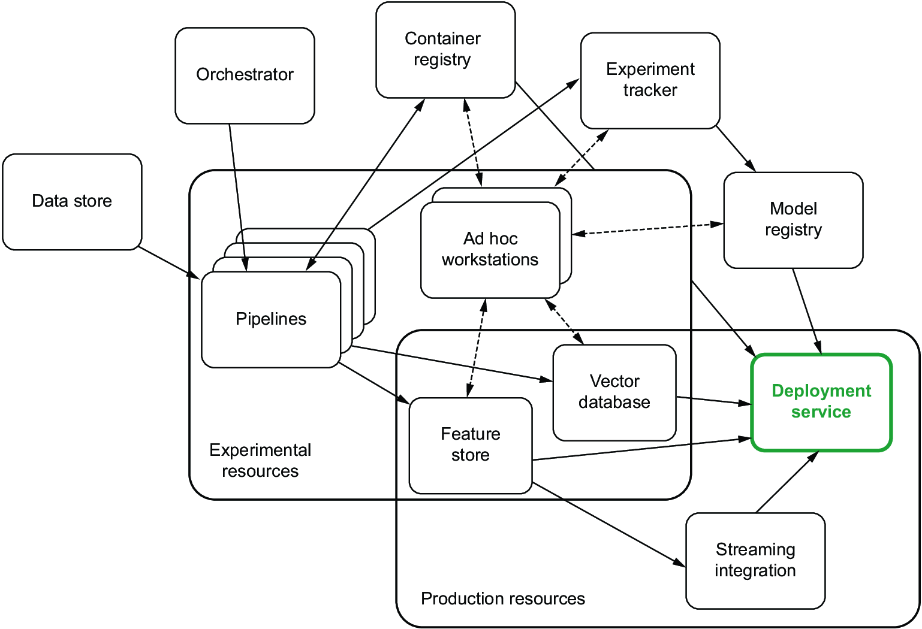
Places the model registry among experiment trackers, feature stores, data systems, deployment services, and other MLOps infrastructure. section 3.4

