Model selection chooses a model structure or algorithm that captures the relationships found in demand data and supports a defined forecasting objective. No single approach is best for every supply-chain situation; data availability, accuracy, horizon, metrics, interpretability, and planning needs shape the choice. section 14.3 section 14.4.2
Use a practical selection process:
- Check whether the required data exists and is reliable before debating advanced techniques. section 14.3
- Inspect demand alongside drivers such as trends, seasonality, holidays, promotions, prices, and regional or product similarities. section 14.4.2
- Try different models and inputs, then compare them with benchmarks, the current forecasting process, and the existing forecasting engine. section 14.3
- Keep a clear winner when accuracy differences are meaningful; otherwise, combine predictions, accepting additional opacity and complexity. section 14.3
- After selection, fit the model and analyze errors to create a feedback loop for improvement. section 14.4.2
Choosing for a supply-chain forecast
A simple time-series forecast may be easier to set up but offers limited data and no scenario planning. Predictive analytics can support scenario planning and capture complicated relationships, but requires advanced analytics and difficult-to-collect data. Compare both against existing practice before choosing. section 14.3
Figure 14.12 4-step model creation loop
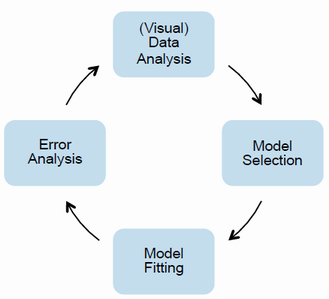
Use the model-creation loop to connect visual data analysis, model selection, model fitting, and error analysis. section 14.4.2








