Model training code is the executable component that receives configured inputs, obtains training data, fits a model, and publishes the resulting model and metrics. A training service can run different implementations when they expose a clear parameter protocol and are packaged consistently. section 3.3.6 section 10.2.2
A production-oriented training component typically performs these steps:
- Reads hyperparameters, dataset locations, and model-output settings from environment variables supplied by the training service. section 3.3.6
- Downloads and parses the dataset, prepares training and validation inputs, and runs the iterative learning process. section 3.3.6
- Uploads the generated model and training metrics to a metadata and artifacts store. section 3.3.6
- Separates training-data transformation when prepared data is reused or must run on a different cadence from training. section 10.2.1
- Packages the component as a Docker container and registers it with a common handle so system services can locate the correct code. section 10.2.2 section 10.2.3
Intent-classification training container
A three-layer neural-network implementation reads EPOCHS and TRAINING_DATA_PATH from environment variables, downloads examples.csv and labels.csv, builds data loaders, trains iteratively, and uploads the model and metrics. A workflow can invoke this container as its training step through a training service. section 3.3.6 section 9.2.1
Figure 3.9 The intent classification training code workflow first reads all the input parameters from environment variables and then downloads the dataset, processes it, and starts the training loop. At the end, it uploads the output model file.
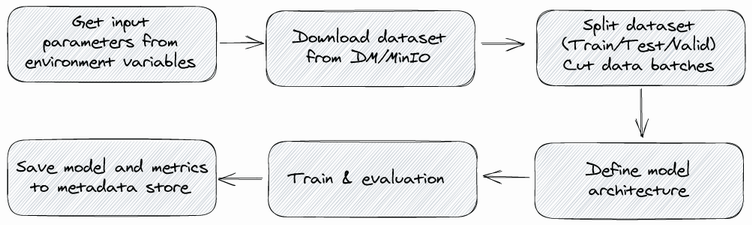
Trace the end-to-end flow from environment configuration through dataset processing and training to model-file upload. section 3.3.6
