A model training service is shared infrastructure for executing model-training code on managed CPU, RAM, and GPU resources. It accepts training requests, schedules jobs, allocates compute, and produces trained model files. Rather than treating training as a local script invocation, it makes remote execution repeatable, scalable, and observable for multiple users. section 1.2.2 section 3.1 section 3.1.1
Figure 3.1 A high-level workflow for executing model training via a training service. In step 1, the data scientist submits a training request with training code to the training service, which creates a job in the job queue. In step 2, the model training service allocates compute resources to execute the training job (training code). In step 3, the job produces a model when the training execution completes.
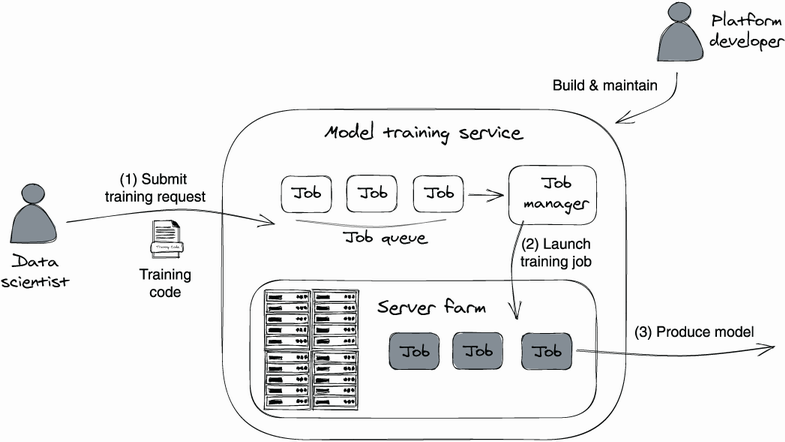
The core flow is submit code, queue a job, allocate resources, and emit a model when execution completes. section 3.1
The service separates responsibilities. Data scientists supply training algorithms, while platform engineers operate the remote shared server farm. A workflow orchestration service can trigger runs; the trainer reads training data from a dataset manager and stores models, metrics, and metadata in a metadata and artifacts store. This record supports comparing experiments, reproducing runs, and troubleshooting. section 1.2.3 section 1.4 section 3.1
A production-oriented training service is designed to:
- Queue concurrent requests and share limited cluster capacity rather than let each user directly control servers. section 1.4 section 3.1.1
- Recover from interrupted jobs, isolate workloads, and adjust compute capacity as demand changes. section 3.1.2
- Track dataset versions, code versions, hyperparameters, metrics, and results for reproduction and performance investigation. section 1.2.3 section 3.1.1
- Protect sensitive training data through restricted access and prepare consistent dependency environments. section 3.1.1
Containerization provides a common execution boundary. Package training code and its libraries as a Docker image, then let the service launch the image as a container instead of configuring every framework directly on each server. A communication protocol supplies the dataset, hyperparameters, model location, and metrics location. This keeps the service agnostic to model architecture while isolating each execution. section 3.2.2 section 3.6
Submitting and tracking a training job
A client starts the service in Docker, sends a gRPC Train request containing algorithm metadata, a dataset ID and version hash, and parameters such as learning rate, epochs, batch size, and fully connected layer size. The service returns a job ID; a GetTrainingStatus request uses that ID to check progress. In the sample design, the request identifies a Docker image, enters a queue, and a job tracker launches the container locally. section 3.3.1 section 3.3.2
Fair scheduling matters in a shared cluster. One team can otherwise fill the queue with many requests and delay others. Dedicated machine pools and per-team queues establish resource-consumption boundaries, but fixed pools can leave capacity idle. Elastic pool sizing, server reassignment, or provisioning can improve utilization; Kubernetes namespaces provide a virtual-cluster approach over shared physical infrastructure. section 3.3.7 section 3.1.2
For distributed training, the service must provision worker groups and configure framework-specific communication details automatically. Users can specify a worker count and framework, while the service initializes the workers with required addresses and task information. This avoids requiring data scientists to manually discover dynamic server assignments. section 4.2.4
Figure 10.7 A typical production model training setup. The workflow service manages what, when, and how training flows are run. The training service runs model training jobs. The metadata and artifacts store provides training code, stores trained models, and associates them with metadata.
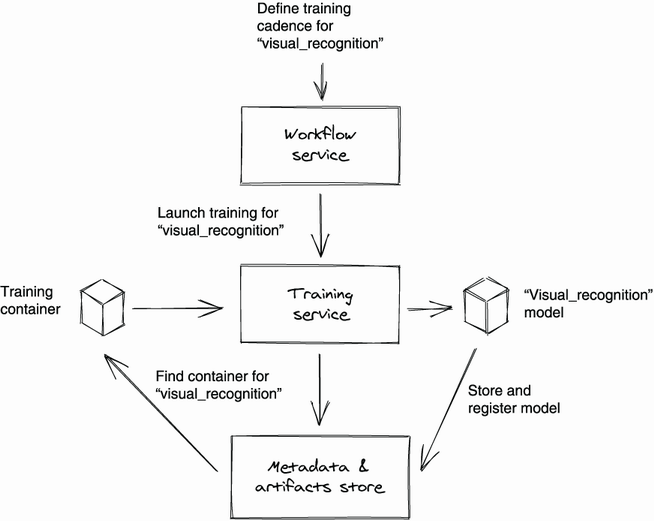
In a production workflow, training code is resolved from the metadata and artifacts store, executed by the training service, and saved back with its model metadata. section 10.2.4
Adopt or build according to operational constraints. Kubeflow training operators offer Kubernetes-based operators for TensorFlow, PyTorch, MXNet, and MPI workloads; containerized jobs can be submitted and monitored through Kubernetes APIs. Public cloud training services can accelerate application delivery, whereas a custom service can offer lower operating cost, custom behavior, and cloud-agnostic deployment when those requirements justify the engineering effort. section 3.4.1 section 3.5.2 section 3.6
