Model-View-Update (MVU), also called the Elm Architecture, is a unidirectional UI pattern. An immutable Model holds application state, the View renders it, and an Update function creates a new Model after user input. section 1.5
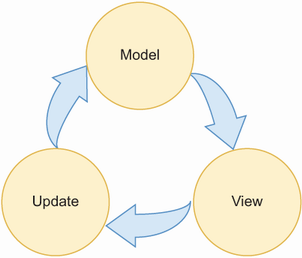
The MVU cycle follows three steps:
- The Model represents the whole application state. section 1.5
- The View displays the current Model and dispatches changes caused by user input. section 1.5
- The Update function receives those changes and produces a new Model instead of mutating the existing one. section 1.5
In .NET MAUI, MVU is an alternative to MVVM and suits developers who prefer defining UI in C# rather than XAML. Support requires a library such as Comet for C# or Fabulous for F#; it was experimental at the stated time and lacked first-party tooling. section 1.5 section 9.3.5
Figure 1.10 In the MVU pattern, the Model represents the whole-application state. Changes in the Model are sent to the View, which changes what is displayed when the Model is updated. Changes in the View are dispatched to an Update function, which generates a new Model.
Trace the complete MVU loop from whole-application state through rendering and input dispatch to a newly generated Model. section 1.5

