Modifiability is the ease and speed with which an application can support changes to its behavior or other qualities after deployment. It is a development-time quality attribute: high modifiability helps teams deliver a continuous stream of small changes and obtain rapid feedback. section 3.1.3 section 5.0
To improve modifiability, design for loose design-time coupling and high cohesion. Changes are then more likely to stay within part of one subdomain, one component, and one team’s code base. This reduces cross-team coordination, avoids complex multi-component changes, and makes subdomains easier to understand. section 5.2.2
Figure 5.7 High modifiability requires a loosely design-time coupled and cohesive architecture that localizes changes to just part of a subdomain in a single component that’s owned by a single team.
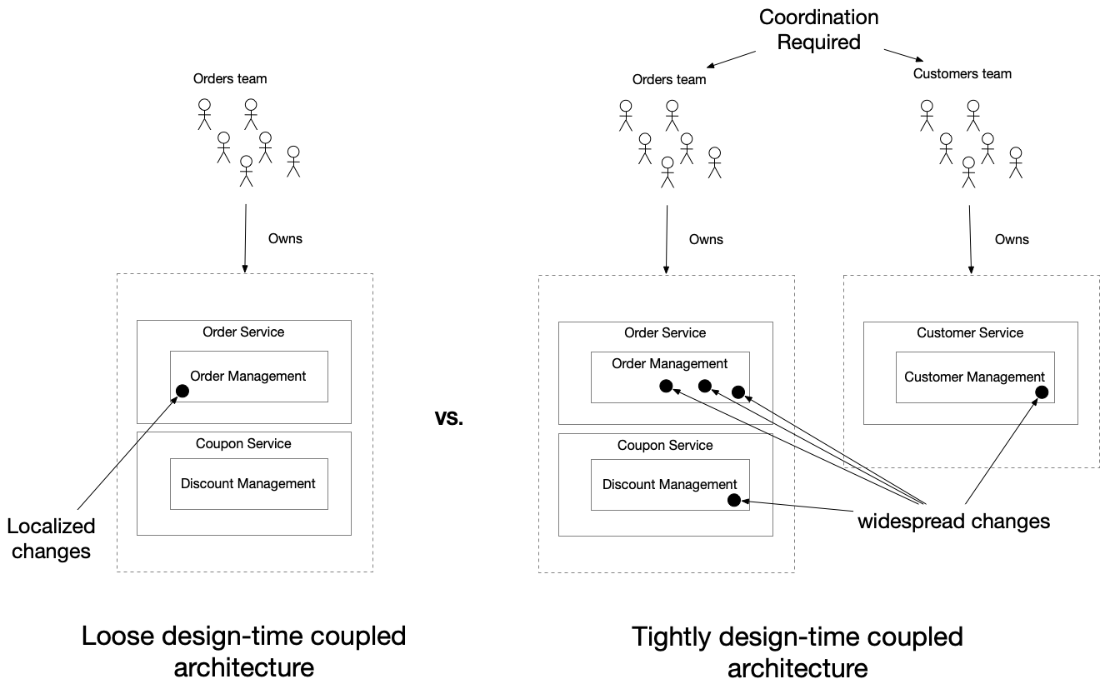
The diagram shows how a cohesive, loosely coupled architecture can localize a change to one component and team. section 5.2.2
Specify modifiability through application-specific quality attribute scenarios. A scenario can identify the requested change, the affected artifact, the expected response, and a measure such as time to make the change. Useful requirements also address how often teams can work autonomously and whether they find changes straightforward. section 3.1.3 section 5.2.1
Changing an order rule
An Orders team owns Order Management and Discounts, deployed as separate services. A modifiability scenario calls for changing an order business rule without coordinating with other teams or changing the Discount Service; a later survey asks whether the change was straightforward. For UI features that also change the Order Service API, the goal is for most API changes to be backward compatible, so coordination is usually unnecessary. section 5.2.1
Architecture choices affect how widely changes spread. A technology-oriented layered structure can work for a small application, but a subdomain scattered across layers may require changes to request handlers, business logic, and persistence for a single new attribute. Loosely coupled microservices can localize changes and support team autonomy, but maintaining that coupling requires discipline and ongoing dependency management. section 6.2.1 section 7.4.1
