A quality attribute scenario turns an architectural requirement into a specific event, expected response, and measure. It applies to runtime qualities, such as availability and performance, and development-time qualities, such as modifiability, testability, and deployability. section 3.1.3
Specify each scenario with six parts:
- Stimulus: the event that occurs. section 3.1.3
- Stimulus source: where the event comes from. section 3.1.3
- Response: the activity triggered by the event. section 3.1.3
- Response measure: a criterion, such as latency, throughput, or time to make a change, used to assess the architecture. section 3.1.3
- Environment: the conditions under which the scenario occurs. section 3.1.3
- Artifact: the affected part of the system. section 3.1.3
Modifiability
An Orders team changes a business rule in Order Management without coordinating with other teams or changing the Discount Service; a survey records whether the change felt straightforward. This makes both the desired scope of change and its assessment explicit. section 5.2.1
Figure 3.3 An example availability scenario, which specifies that the application continues to handle requests when a service instance, such as the FTGO application’s Order Service, fails
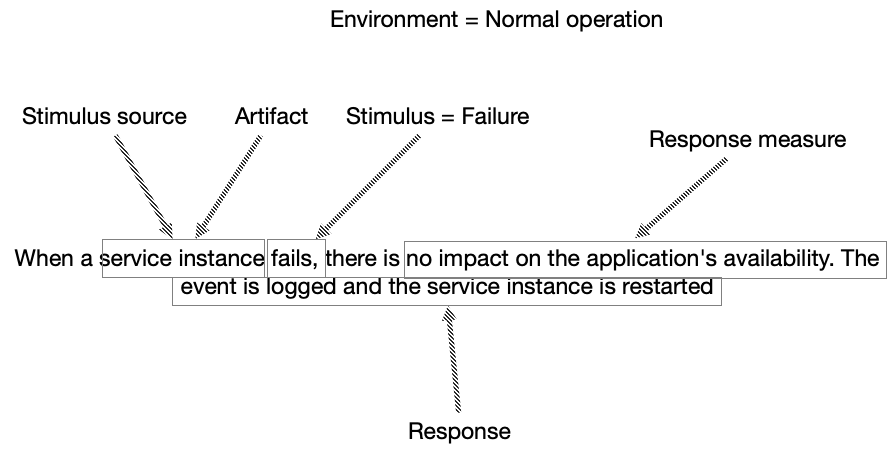
The availability scenario illustrates a runtime requirement: requests continue to be handled when a service instance fails. section 3.1.3
