liveBook · Manning

Modulo arithmetic

As explained in Real-World Cryptography

Modular arithmetic is arithmetic in which values are identified according to their remainders after division by a fixed modulus.

Modulo arithmetic makes numbers wrap around after reaching a fixed modulus. With modulus 5, 6 becomes 1, 7 becomes 2, and 5 is represented as 0. section 5.2.1

Use remainders to perform modular arithmetic:

  • Divide a number by the modulus and keep the remainder: 7 = 5 × 1 + 2, so 7 is congruent to 2 modulo 5. section 5.2.1
  • Reduce multiplication the same way: 3 × 2 = 6, which becomes 1 modulo 5. section 5.2.1
  • Recognize inverses among the nonzero values: modulo 5, 3 and 2 are inverses because their product is 1. section 5.2.1
Figure 5.5 The group of integers modulo the prime number 5 can be pictured as a clock that resets to 0 after the number 4. Thus 5 is represented as 0, 6 as 1, 7 as 2, 8 as 3, 9 as 4, 10 as 0, and so on.
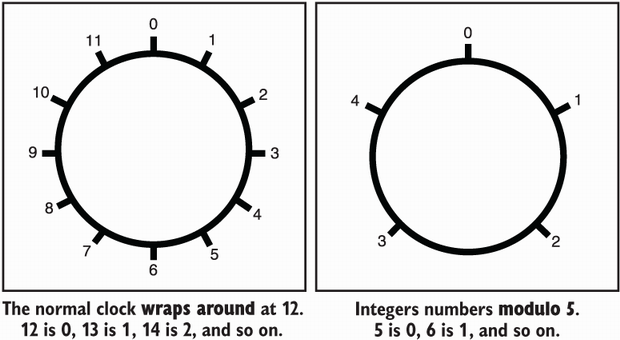
Picture the values as a clock that resets to 0 after 4: 5 becomes 0, 6 becomes 1, and 10 becomes 0. section 5.2.1


How Real-World Cryptography covers it

How deep it goes
Defines remainders, demonstrates multiplication and inverses, and connects the operation to multiplicative groups.
Examples
Uses a clock analogy, division by 5, and the product 3 × 2 modulo 5.
What it assumes
Builds from ordinary division and multiplication before introducing congruence notation and group operations.
What you can do after
Apply modular reduction to simple divisions and multiplications, and identify multiplicative inverses modulo 5.
How it connects
Connects modular arithmetic with group theory, prime numbers, modular multiplication, inverses, and Diffie–Hellman.

Also explained in

Compare how 3 books explain modulo arithmetic →

Related concepts

This explainer was generated by Manning's knowledge graph from the text of Real-World Cryptography. The section links point to the parts of the book it draws on.
