A mount namespace isolates the filesystem mount points visible to a process. It gives each container its own view of the filesystem, so processes in different containers do not automatically see the same mounted filesystems. section 2.3.1
Linux organizes resources into namespaces, or smaller visibility buckets. A process belongs to a namespace for each resource type, including mount points, process IDs, network interfaces, and user IDs. The mount namespace is the resource-specific boundary for filesystems. section 2.3.1
Two containers sharing selected files
Two containers in the same pod still use separate mount namespaces. If both need access to part of the same filesystem, a volume can be added to the pod and mounted into both containers. The volume is shared even though the mount namespaces remain separate. section 5.1.1
This boundary differs from namespaces that a pod may share. Containers can share network, IPC, or UTS namespaces, and a pod can optionally use one PID namespace; each container nevertheless retains its own mount namespace. section 5.1.1
Figure 2.17 Each process is associated with multiple namespace types, some of which can be shared.
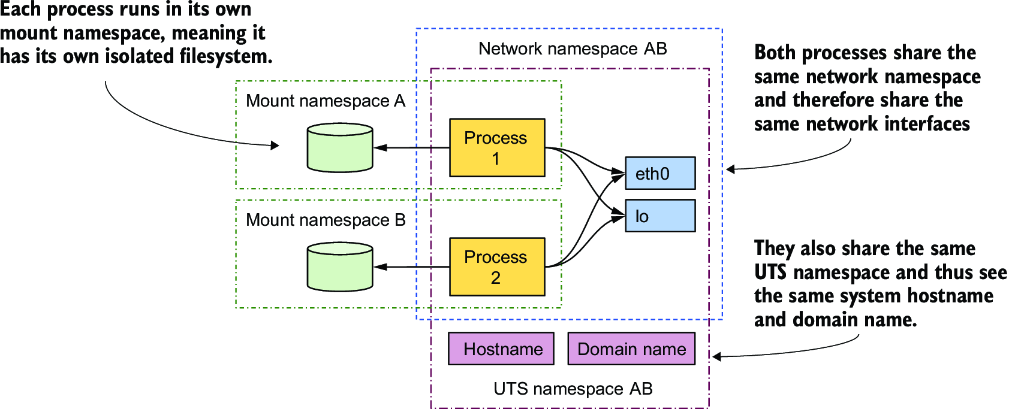
Use the namespace overview to compare mount isolation with the other namespace types associated with a process. section 2.3.1