liveBook · Manning

Multi-dimensional optimization problem

As explained in Optimization Algorithms: AI techniques for design, planning, and control problems

Multi-objective optimization is an optimization formulation involving multiple objective functions that may need to be balanced or traded off.

A multi-dimensional optimization problem balances multiple objective functions rather than optimizing a single measure. Its decision variables define possible designs or actions, while objectives may conflict and require trade-offs. section 1.3.2

Electric vehicle design

An electric vehicle can minimize acceleration time while maximizing EPA driving range. Wheel size, motor power, and battery capacity act as decision variables: a larger battery increases range but adds weight, worsening acceleration. Preference-based optimization or Pareto optimization can represent these competing goals. section 1.3.2

Figure 1.6 Electric vehicle design problem for maximizing EPA range and minimizing acceleration time
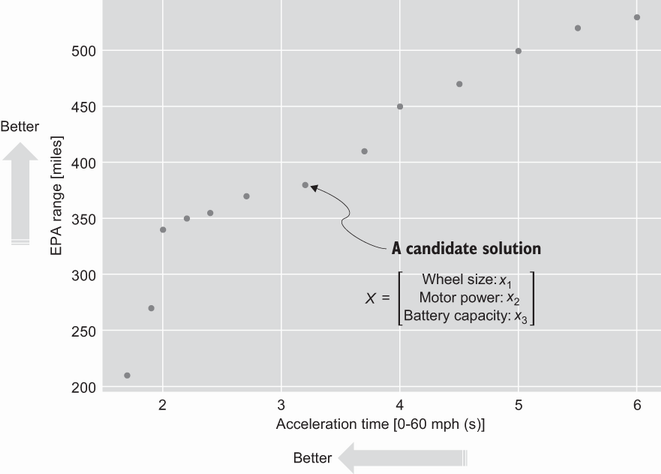
Use the figure to compare the electric vehicle’s conflicting objectives and design variables. section 1.3.2

How Optimization Algorithms: AI techniques for design, planning, and control problems covers it

How deep it goes
Defines conflicting objectives, identifies decision variables, and names preference-based and Pareto approaches without detailing their procedures.
Examples
Uses ticket pricing as a single-objective contrast and electric vehicle design as a conflicting-objectives example.
What it assumes
Distinguishes single-objective optimization from problems involving multiple objective functions.
What you can do after
Evaluate design trade-offs using preference-based or Pareto optimization approaches.
How it connects
Connects objective functions, decision variables, mono-objective optimization, preference-based optimization, Pareto optimization, and genetic algorithms.

Related concepts

This explainer was generated by Manning's knowledge graph from the text of Optimization Algorithms: AI techniques for design, planning, and control problems. The section links point to the parts of the book it draws on.