Pareto optimization handles conflicting objectives by finding multiple trade-off solutions instead of forcing every goal into one weighted score. It reduces the alternatives to a Pareto frontier: an optimal set of nondominated solutions from which a final choice can be made using higher-level information. section 1.3.2 section 8.9
Use the approach when:
- Objectives conflict and assigning subjective weights would obscure the decision. section 1.3.2
- Several nondominated alternatives should remain available for strategic decision-making. section 1.3.2
- A genetic algorithm is being adapted for multi-objective optimization; crossover and mutation can help explore candidate solutions. section 8.9
Electric vehicle design
Choose wheel size, motor power, and battery capacity while maximizing EPA driving range and minimizing acceleration time. A larger battery can extend range but add weight, increasing acceleration time. Rather than selecting weights for the two objectives in advance, Pareto optimization identifies the available range–acceleration trade-offs. section 1.3.2
Figure 1.6 Electric vehicle design problem for maximizing EPA range and minimizing acceleration time
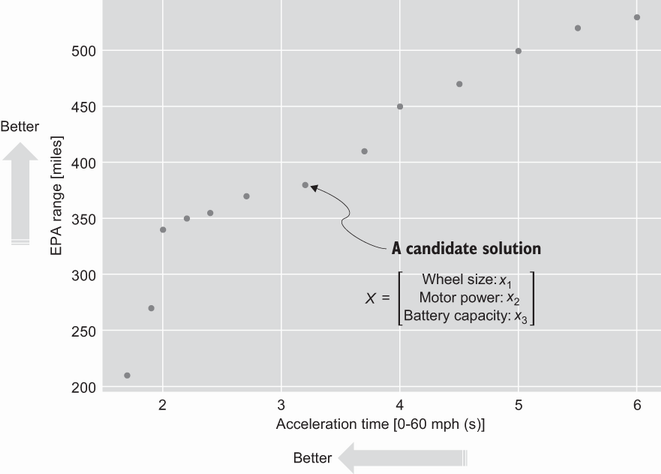
Inspect the electric-vehicle design figure to compare the two competing objectives. section 1.3.2