Multitenancy lets teams or customers share a platform while enforcing explicit tenant boundaries, resource limits, and access guarantees. On Kubernetes, platform teams must decide how much isolation each tenant needs and encode that decision in the platform architecture. section 6.2.1 section 6.2.3
Common Kubernetes tenancy choices trade operational cost against isolation and control:
- Namespaces provide cheap logical boundaries with little overhead, but require RBAC for visibility control and resource quotas to prevent resource exhaustion. section 6.2.3
- Namespace tenants share the Kubernetes API server, limiting cluster-wide installations, API-scale independence, and the ability to run conflicting extension versions. section 6.2.3
- Separate Kubernetes clusters provide stronger isolation, independent API endpoints, and tenant-level control over configuration, scalability, resilience, and installed tools. section 6.2.3
- vcluster creates virtual Kubernetes clusters inside a host cluster, giving tenants isolated API servers and, when required, cluster-wide control without provisioning separate physical clusters. section 6.3.1
Choosing vcluster for tenant environments
Use namespaces when teams only need workload access within assigned boundaries. Use vcluster when each tenant needs Kubernetes API access and freedom to install cluster-wide tools. Create a virtual cluster with the vcluster Helm chart or CLI, then connect the tenant to its isolated API server. section 6.3.1 section 6.2.3
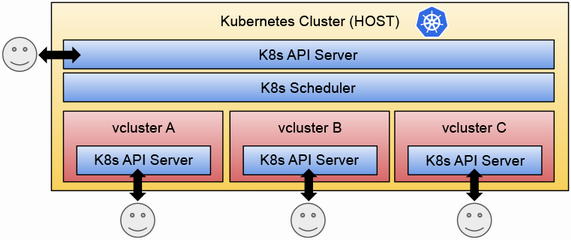
Inspect the architecture showing how vcluster isolates tenants at the Kubernetes API-server layer. section 6.3.1
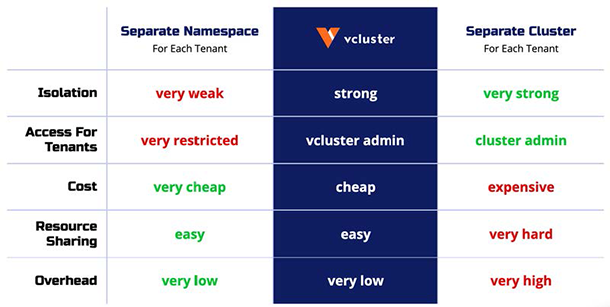
Compare the operational advantages and limitations of namespaces, vcluster, and separate Kubernetes clusters. section 6.3.1


