High-dimensional data represents each input instance as a feature vector with many dimensions. In a data matrix, rows represent instances and columns represent feature dimensions; geometrically, each row is a point in feature space. section 2.13 section 4.0
Machine learning searches these spaces for patterns. Points from a class may occupy a relatively small subregion rather than being spread uniformly, creating structure that linear algebra can analyze. section 2.13 section 4.0
High dimensionality matters because it supports both pattern discovery and simplification:
- Treat each feature vector as a point whose coordinates specify an input instance in feature space. section 2.13
- Transform the feature space when some axes show little variation, reducing dimensions while preserving broader patterns. section 2.13
- Use PCA to project multidimensional data onto its first principal axes when storage or representation must be reduced. section 4.4.5
Compression through principal components
Given a large multidimensional dataset and a fixed byte budget, discard components associated with smaller principal values and store projections onto the first few principal axes. This reduces the number of components while limiting information loss. section 4.4.5
Figure 2.13 During rotation, points on the axis of rotation do not change position.
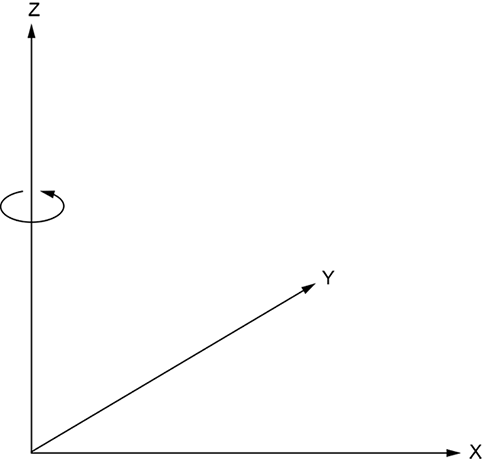
Use the rotation analogy to visualize how a transformation can leave an axis unchanged, motivating eigenvectors as tools for analyzing structured feature spaces. section 2.13


