A multifidelity BayesOpt loop finds an expensive objective’s optimum by choosing both where to query and which fidelity to use. It exploits inexpensive, imperfect approximations while reserving costly ground-truth evaluations for promising regions. section 9.0 section 9.1
The loop repeats three decisions:
- Train a Gaussian process on observations from both the high-fidelity ground-truth function and the low-fidelity approximation. section 9.1
- Score each data point–fidelity pair with an acquisition value that balances expected optimization progress against query cost. section 9.1 section 9.3
- Query the fidelity attached to the highest-scoring pair, add the observation to the training data, and repeat. section 9.1
Forrester-function search
A low-fidelity approximation of the Forrester function differs from the ground truth but follows roughly the same shape. The policy can sample the approximation broadly, then query the ground truth to refine the likely optimum. section 9.1
Figure 9.1 Model of a multifidelity decision-making problem, where the agent needs to balance querying the true objective function f(x) for accurate information and querying the inexpensive surrogate f̄(x)
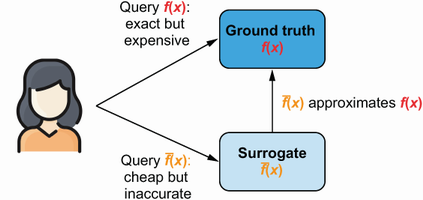
Use the decision diagram to see the central trade-off between accurate, expensive ground-truth queries and inexpensive surrogate queries. section 9.1
