Multifidelity Max-value Entropy Search (multifidelity MES) is a cost-aware Bayesian optimization policy for expensive objectives with cheaper, imperfect approximations. At each step, it chooses both an input location and a fidelity level, aiming to learn about the true objective’s maximum without spending the full budget on every evaluation. section 9.3.2
The policy treats a query’s information about the highest true objective value as its benefit and its evaluation price as its cost. Its acquisition score is return on investment: information gain about the optimum per unit cost. Maximizing this score can favor low-fidelity evaluations when they are cheap and informative, while favoring high fidelity when low-fidelity evidence is insufficient or nearly as costly. section 9.3.2
Figure 9.10 The formula of the ROI acquisition score for multifidelity optimization. This score quantifies the amount of information a query provides about the objective’s optimum for each unit of cost.
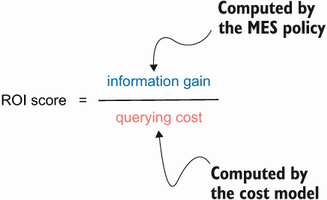
Use the ROI score to compare every candidate input-fidelity pair on a common scale: expected information about the optimum divided by query cost. section 9.3.2
A practical optimization loop is:
- Model the cost of querying each candidate at each available fidelity. section 9.3.2
- Generate candidate inputs at the target fidelity for the MES information calculation, then construct a cost-aware multifidelity MES acquisition function. section 9.3.2
- Optimize over the input domain while restricting the fidelity coordinate to the available levels, and evaluate the selected pair. section 9.3.2
- Track budget spent and recommend the input that maximizes the posterior mean at target fidelity rather than relying on the best observed high-fidelity value. section 9.4
Multiple approximations of Branin
With two low-fidelity Branin approximations and the ground truth, multifidelity MES applies the same information-per-cost rule across all three choices. The approximations have fidelity values 0.1 and 0.3, with costs 0.3 and 0.5, while the true function has fidelity 1 and cost 1.2; higher fidelity more closely resembles the ground truth. section 9.6
Assess progress by the true objective value at the posterior-mean maximizer as budget is spent. A high-fidelity incumbent is misleading: low-fidelity observations may locate the promising region even before any high-fidelity observation exists. Repeated runs can then be averaged to compare multifidelity MES with single-fidelity MES. section 9.4 section 9.5
