Multifidelity optimization searches for the optimum of an expensive objective by choosing among information sources with different accuracy and cost. A high-fidelity evaluation gives exact information but may consume substantial time, money, or effort; a low-fidelity approximation is cheaper but imperfect. The central decision is both where to evaluate and which fidelity to query. section 9.0 section 9.1
Figure 9.1 Model of a multifidelity decision-making problem, where the agent needs to balance querying the true objective function f(x) for accurate information and querying the inexpensive surrogate f̄(x)
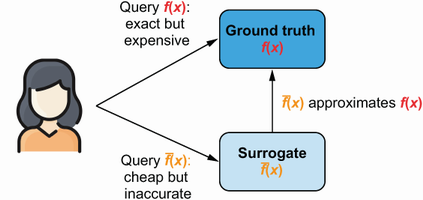
The decision is a balance between an accurate, costly objective evaluation and an inexpensive, inexact surrogate evaluation. section 9.1
A fidelity expresses how informative a source is about the ground truth. Correlations range from 0 to 1: 1 denotes the objective itself, while larger values for an approximation indicate closer agreement and more useful information. Each observation can store its fidelity as an extra feature, allowing a multifidelity Gaussian process to learn from mixed sources while retaining appropriate uncertainty. section 9.2.1 section 9.2.2
Forrester function with a cheap approximation
For a one-dimensional Forrester objective, a low-fidelity approximation with correlation 0.5 supplies inexact but useful shape information. A training set may mix a few high-fidelity observations with many low-fidelity observations; the GP prediction passes through high-fidelity data while uncertainty can also shrink near lower-fidelity data. Overstating the correlation causes overconfidence in the approximation. section 9.2.1 section 9.2.2
Cost must be modeled alongside information. A linear fidelity cost model can assign a fixed cost plus a weight times the fidelity value, making higher-fidelity queries more expensive. The units can represent time, money, or effort, and the known-cost model is used to keep optimization decisions modular. section 9.3.1
A cost-aware multifidelity BayesOpt policy can use Max-value Entropy Search (MES) to estimate information about the objective’s optimum, then divide that information gain by query cost. This return-on-investment score can favor cheap approximations, but it can favor high fidelity when only low-fidelity data exists or when lower fidelity is nearly as costly. section 9.3.2
Evaluate progress by the objective value at the posterior-mean maximizer against budget spent, rather than by the best observed high-fidelity value. A high-fidelity incumbent ignores useful low-fidelity exploration and cannot be computed when no high-fidelity point has been queried. Repeated runs can be averaged for a broader policy comparison. section 9.4 section 9.5
More than one approximation
The same policy can select among two low-fidelity approximations and the objective. In a two-dimensional Branin setup, fidelities 0.1, 0.3, and 1 have increasing resemblance to the ground truth and corresponding linear costs; choose the query with the greatest information per cost. section 9.6