A multivariate test evaluates several features jointly instead of judging each value independently. In outlier detection, this exposes unusual records whose individual values may look reasonable but whose combination is suspicious, such as an unusual salary given a staff member’s start date and department. section 3.0 section 4.7
Use multivariate tests with deliberate feature preparation:
- Check related fields together when their relationship carries meaning; Staff ID and Start Date can be compared through their rank order. section 4.7
- Remove irrelevant or noisy columns before testing. Staff ID may help with a targeted consistency check but add noise to broader multivariate detection. section 4.7
- Prefer meaningful feature subsets when many columns make distance calculations questionable; all available features are not automatically the best input. section 4.7
- Choose the detector according to the data and operational constraints. Options include multidimensional KDE, multidimensional histograms, nearest-neighbor calculations, trees, neural networks, clustering, compression, and Markov models. section 3.0
Staff records
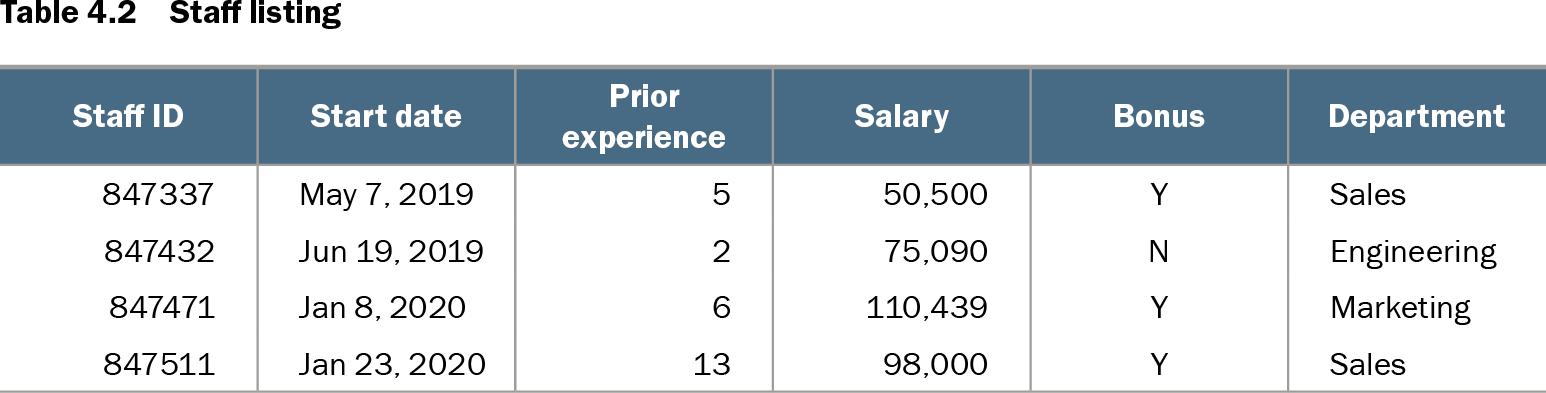
A staff table can test whether Staff ID and Start Date preserve the expected rank order, then examine combinations such as Start Date, Department, and Salary. A mismatched identifier or an unusual salary for a person’s start date and department becomes a candidate for investigation, not an automatically confirmed error. section 4.7
Table 4.2 Staff listing (view table figure)
| Staff ID |
Start date |
Prior experience |
Salary |
Bonus |
Department |
|---|---|---|---|---|---|
| 847337 |
May 7, 2019 |
5 |
50,500 |
Y |
Sales |
| 847432 |
Jun 19, 2019 |
2 |
75,090 |
N |
Engineering |
| 847471 |
Jan 8, 2020 |
6 |
110,439 |
Y |
Marketing |
| 847511 |
Jan 23, 2020 |
13 |
98,000 |
Y |
Sales |
Inspect the staff listing to see the fields available for targeted consistency checks and multivariate feature selection. section 4.7