MuseGAN generates multitrack music by treating a complete piece as a multidimensional object, much like an image. A generator creates the object; a critic scores it against real music. Unlike a sequence model that predicts the next musical event, this approach generates the piece as a structured whole. section 13.0
A training piece has shape (4, 2, 16, 84): four tracks, two bars per track, 16 steps per bar, and 84 possible pitches per step. Bach chorales provide the training examples, so the intended output resembles their style. section 13.6 section 13.3
Four random latent vectors divide control over the piece:
- Chords influence the tracks together and can change between bars. section 13.2 section 13.4.2
- Style remains shared across tracks and constant across both bars. section 13.2 section 13.4.2
- Melody gives tracks separate control and can change between bars. section 13.2 section 13.4.2
- Groove gives each track its own control while remaining constant across bars. section 13.2 section 13.4.2
The generator expands chords and melody along the bar dimension with temporal networks, then uses bar generators to construct one track-bar segment at a time. The critic instead applies convolutional layers to a full (4, 2, 16, 84) piece and returns an unrestricted score, not a real-or-fake classification. section 13.4.2 section 13.4.1
During training, the critic scores real and generated pieces, while the generator learns to obtain higher scores. A gradient penalty uses an interpolation between real and generated pieces to help stabilize the critic’s training. section 13.2.2
Figure 13.6 A diagram of the steps involved in training MuseGAN to generate music. The generator produces a fake music piece by drawing four random noise vectors from the latent space (top left) and presents it to the critic (middle). The critic evaluates the piece and assigns a rating. A high rating suggests that the piece is likely from the training dataset, while a lower rating indicates that the piece is likely fake (generated by the generator). Additionally, an interpolated music piece created from a mix of real and fake samples (top left) is presented to the critic. The training process incorporates a gradient penalty based on the critic’s rating of this interpolated piece, which is added to the total loss. The ratings are then compared to the ground truth, allowing both the critic and the generator to learn from these evaluations. After numerous training iterations, the generator becomes proficient at producing music pieces that are virtually indistinguishable from real samples.
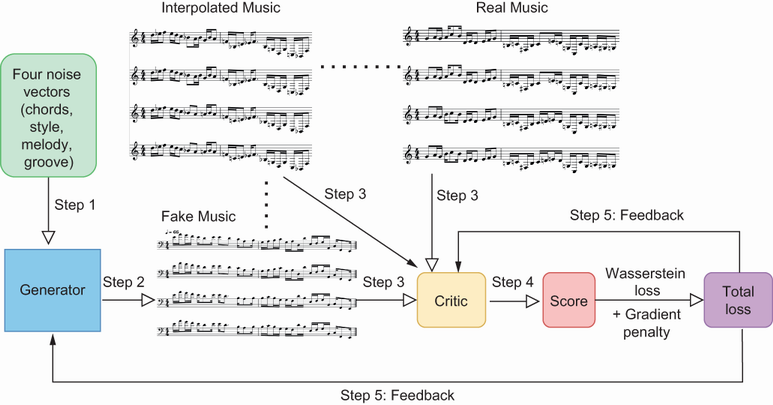
Follow the four latent inputs through the generator, then compare how real, generated, and interpolated music enter the critic. section 13.2.2
Generate a playable piece
Draw five sets of random chords and style vectors with shape (5, 32), and melody and groove vectors with shape (5, 4, 32). Pass them to a trained generator, then use convert_to_midi() to join the five resulting music objects into one MIDI file. Playback offers a direct comparison with the training music; new random vectors produce a different result. section 13.5.2
