Named entity recognition (NER) identifies mentions in unstructured text and assigns them to predefined categories such as people, organizations, locations, diseases, organisms, or procedures. It converts raw text into structured entities that can support knowledge graphs, search, compliance, information management, and analysis. section 5.2.1 section 7.0
A practical NER pipeline typically follows these stages:
- Define the entity categories required by the domain instead of relying only on generic Person, Location, or Organization labels. section 5.2.1
- Extract mentions from text and classify them against the permitted categories, often sentence by sentence. section 8.4.1
- Return structured records containing the sentence, mention, label, and character offsets. section 8.4.1
- Pass recognized entities to relation extraction, entity resolution, or named entity disambiguation when precise identity and meaning are required. section 5.4 section 7.1
Biomedical prompt-based extraction
A prompt can restrict an LLM to categories retrieved from SNOMED and request valid JSON. For the sentence “Severe outcomes of Zika are due to its capacity to cross the placental barrier during pregnancy, causing microcephaly and congenital malformations,” the output identifies Zika as an Organism and the latter terms as Clinical findings, with character offsets. section 8.4.1
Figure 8.2 Workflow for a NED system designed to use LLMs and domain-specific ontologies, such as SNOMED, for biomedical text processing. Each stage of this workflow involves interactions to accurately disambiguate entities in the input text.
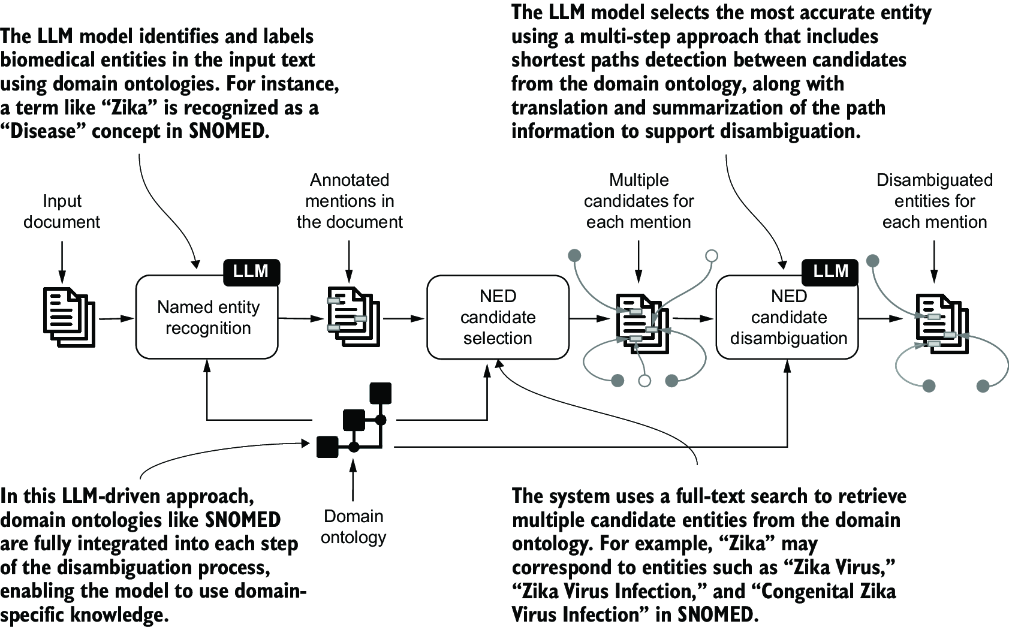
The workflow diagram shows NER as the first stage of an ontology-backed biomedical disambiguation pipeline, followed by candidate selection and candidate disambiguation. section 8.4



