Imagine describing what you need in plain English and having a programming assistant draft code. Natural language makes that interaction possible: it is the human framework for expressing requests and communicating responses. The same capability supports customer-service and shopping assistants. section 1.1
Language is also an abstraction. Words express thoughts and feelings without capturing everything behind them. That gap matters when a language model handles a request: a fluent response does not guarantee that the intended meaning has survived. section 2.1
Use the communication benefit without treating it as a reason to deploy an LLM everywhere:
- Consider language-based assistants for conversations, recommendations, and programming help. section 1.1
- Avoid an LLM for simple problems that demand low latency or carry high risk. section 1.4
Figure 2.1 We compare cognitive layers of abstraction to programming layers of abstraction down to the logical binary abstraction. Python doesn’t come from C, nor does it compile into C. Python is, however, another layer of abstraction distant from binary. Language follows a similar path. Each layer of abstraction creates a potential point of failure. There are also several layers of abstraction to creating a model, and each is important in seeing the full path from our feelings to a working model.
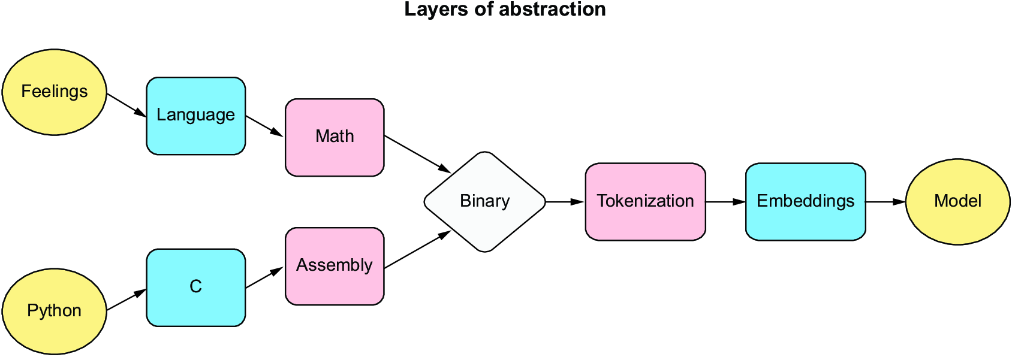
The abstraction diagram places language between internal experience and more formal representations. It highlights why each step away from an intended meaning can introduce a point of failure. section 2.1



