Natural selection describes how variation, survival, and reproduction favor traits that help organisms adapt to changing environments. Evolutionary computation turns this idea into a search process: simulate individuals, measure their fitness, and evolve better-performing solutions. section 2.4.3 section 1.1.1
A simplified computational model emphasizes:
- Representing one individual or a population of individuals inside an environment or problem space. section 1.1.1
- Quantifying performance with fitness, which determines how effectively an individual survives, thrives, or solves the problem. section 1.1.1
- Encouraging change and diversity rather than preserving only the current strongest individuals, because adaptation can accelerate problem solving. section 2.4.4
The biological analogy is deliberately simplified. Natural selection motivates evolutionary computation, but computational terminology does not transfer perfectly from biology. The practical goal is evolutionary change: producing solutions that respond well to changing conditions, not merely selecting the strongest current solution. section 2.4.4
Experiment with evolutionary operators
Construct gene sequences, then change the target function or alter crossover, selection, mutation, and other operators. Rerunning the experiment reveals how the available operators and their parameters affect evolution. section 4.1.2
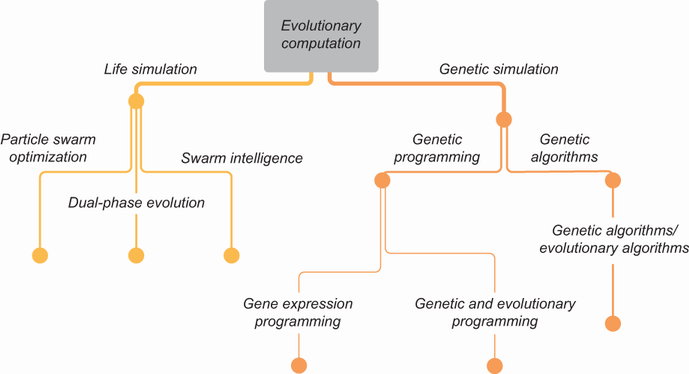
Use the figure to locate natural selection within the subset of evolutionary computation applied to evolutionary deep learning. section 1.1.1


