A network effect makes a product more valuable to existing users as each additional user joins. It is one of four competitive moats. section 5.4
Use network effects to reason about defensibility:
- Treat growth as a value-creation loop, not merely an acquisition metric. section 5.4
- Compare network effects with switching costs, brand, and counter-positioning when identifying a product's moat. section 5.4
- Predict engineering and business investment from the moat the product actually holds. section 5.4
Figure 5.7 The four competitive moats, or reasons a rival can't catch up: switching costs (leaving costs too much), network effects (each new user adds value), brand (a trusted name), and counter-positioning (copying you would break the rival, just as matching a "free" price would drain an incumbent's revenue). Cal.com combines counter-positioning with switching costs, and the moats a product holds predict where it invests next.
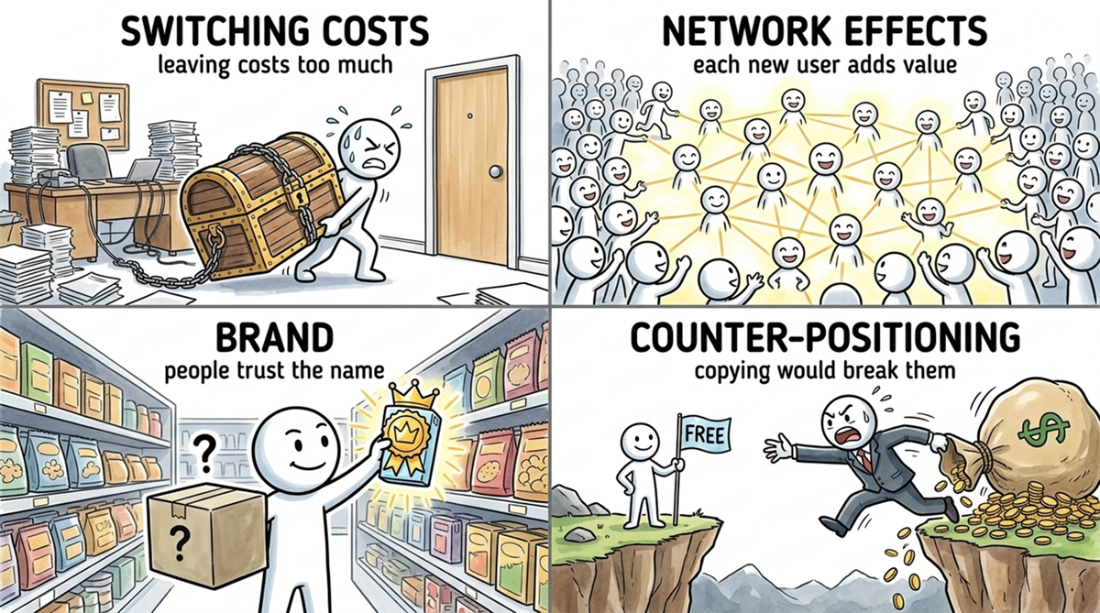
The moat comparison distinguishes network effects from switching costs, brand, and counter-positioning, making the concept easier to evaluate alongside competing defenses. section 5.4


