liveBook · Manning

Network jitter

As explained in Acing the CCNA Exam: Volume 2 Advanced Networking and Security

Network jitter is variation in the delay of successive data packets or flows.

Network jitter is the variation in delay across a series of packets. Delay is unavoidable, but consistent delay is preferable; excessive variation harms real-time applications such as voice and video calls. section 10.2.2

Jitter is measured in milliseconds. Cisco recommends keeping jitter at 30 ms or less for voice traffic. QoS aims to minimize jitter, delay, and packet loss during congestion. section 10.2.2 section 10.7

Distinguish jitter from related performance measurements:

  • Delay measures one-way travel time from source to destination. section 10.2.2
  • Round-trip time measures travel to the destination and the reply back to the sender. section 10.2.2
  • Loss measures the percentage of packets that fail to reach their destination; Cisco recommends 1% or less for voice traffic. section 10.2.2
Figure 10.6 Jitter is the variation in delay in a series of packets.
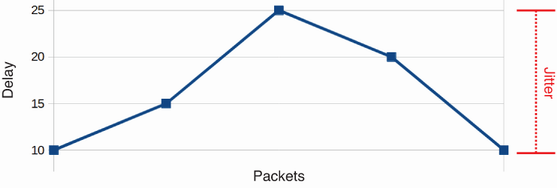
Visualizes jitter as variation in packet delay across a series of packets. section 10.2.2

How Acing the CCNA Exam: Volume 2 Advanced Networking and Security covers it

How deep it goes
Defines jitter, gives its measurement unit and voice threshold, and contrasts it with delay, RTT, and loss.
Examples
Uses voice calls, video calls, and a figure showing variation in packet delay as concrete illustrations.
What it assumes
Assumes basic understanding of packets and networks while defining delay, RTT, jitter, and loss explicitly.
What you can do after
Evaluate real-time traffic quality by distinguishing jitter from delay, RTT, and packet loss.
How it connects
Connects jitter with quality of service, delay, round-trip time, packet loss, congestion, and real-time applications.

Related concepts

This explainer was generated by Manning's knowledge graph from the text of Acing the CCNA Exam: Volume 2 Advanced Networking and Security. The section links point to the parts of the book it draws on.