Network congestion occurs when traffic demand exceeds available capacity, creating bottlenecks that can reduce performance. Its effects include delay, jitter, and packet loss. section 10.0 section 10.2.1
Bandwidth is often unevenly distributed across a network. End hosts may have 1 Gbps links while WAN or Internet connections provide less capacity, especially because remote connectivity is expensive. During peak usage, these narrower links become congestion points. section 10.2.1
Congestion affects traffic according to its sensitivity:
- Voice calls and video meetings are highly sensitive to delay, jitter, and loss, so congestion can severely damage the user experience. section 10.2
- File downloads tolerate congestion better; completion may take longer without changing the overall interaction as severely. section 10.2
- Quality of service prioritizes important traffic and de-prioritizes less important traffic when congestion occurs. section 10.0
Interface queues cannot grow indefinitely. When queues overflow, tail drop discards packets. TCP receivers respond to loss by reducing their advertised window, then gradually increasing it again to discover a usable transmission rate. section 10.6 section 10.6.1
TCP global synchronization
If many TCP hosts lose packets through tail drop at the same time, they simultaneously reduce their window sizes. Network utilization falls; as windows recover, traffic rises and congestion returns, repeating the cycle. section 10.6.1
Figure 10.4 Different areas of the network have different total bandwidths. The LAN has two 1 Gbps WAN connections, which are potential bottlenecks.
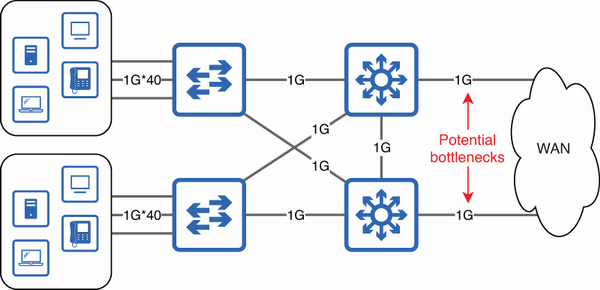
Use the bandwidth comparison to locate potential WAN bottlenecks between higher-capacity LAN segments. section 10.2.1
Figure 10.24 The vicious cycle of TCP global synchronization
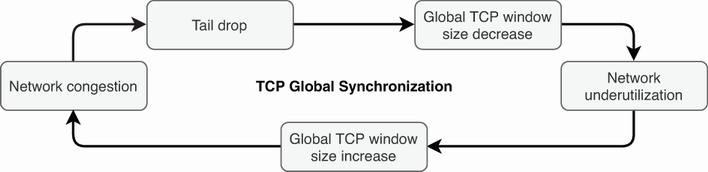
Use the cycle diagram to trace how tail drop produces simultaneous TCP reductions, underutilization, recovery, and renewed congestion. section 10.6.1
