Tail drop occurs when an incoming packet is assigned to a queue but cannot enter because the queue has reached capacity. The packet is discarded. section 10.6.1
Packet loss can trigger TCP retransmissions, but simultaneous losses across many hosts can produce TCP global synchronization. Affected receivers sharply reduce their TCP window sizes, then gradually increase them again. This cycle causes underutilization, renewed congestion, and further tail drops. section 10.6.1 section 10.7
Distinguish tail drop from related queue-management behavior:
- RED randomly drops a percentage of packets after a queue exceeds a threshold, helping avoid tail drop. section 10.7
- WRED extends RED by providing more control over which packets are dropped. section 10.7
- Avoid RED and WRED for traffic types that are sensitive to packet loss. section 10.7
Figure 10.23 Tail drop occurs when queues fill up and cannot contain more packets.
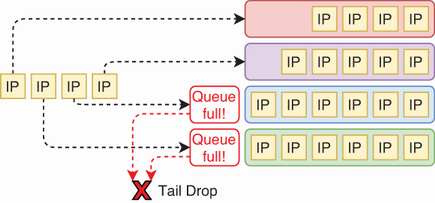
Use the queue diagram to visualize packets being discarded when full queues cannot accept additional traffic. section 10.6.1
Figure 10.24 The vicious cycle of TCP global synchronization
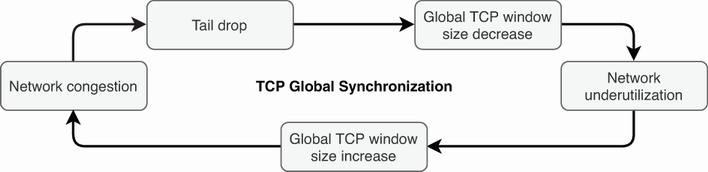
Use the cycle diagram to trace how tail drop drives synchronized TCP window reductions, underutilization, increases, congestion, and renewed loss. section 10.6.1
