Packet loss is the percentage of packets that fail to reach their destination during a period. QoS aims to minimize loss during congestion, with Cisco recommending 1% or less for voice traffic. section 10.2.2
Packet loss behaves differently across traffic types:
- Congestion can force devices to drop packets when queues become full; this specific behavior is called tail drop. section 10.6.1
- TCP-based applications recover from dropped packets through retransmissions, although repeated loss can reduce transmission rates. section 10.2.2 section 10.6.1
- UDP-based VoIP protocols do not retransmit deliberately, because waiting would add delay; excessive loss produces choppy or interrupted audio. section 10.2.2
- Simultaneous tail drop across many TCP hosts can trigger TCP global synchronization: window sizes shrink together, causing underutilization before increasing again. section 10.6.1
Congested voice traffic
During congestion, dropped packets may leave a VoIP call sounding broken up, while a file download may simply take longer. QoS prioritizes traffic whose user experience is more sensitive to loss. section 10.2 section 10.2.2
Figure 10.23 Tail drop occurs when queues fill up and cannot contain more packets.
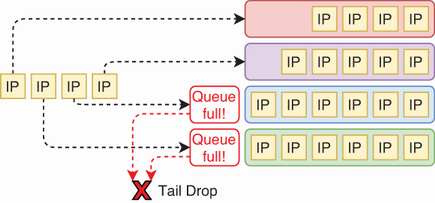
Visualizes tail drop when queues are full and cannot accept additional packets. section 10.6.1
Figure 10.24 The vicious cycle of TCP global synchronization
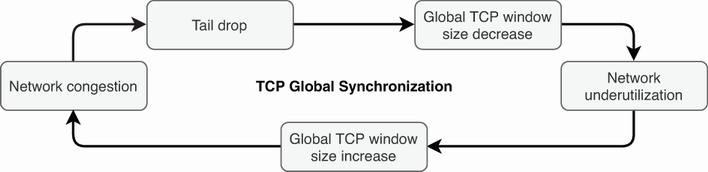
Visualizes the recurring TCP global synchronization cycle caused by simultaneous packet loss. section 10.6.1
