Neural combinatorial optimization applies machine-learning models and algorithms to discrete, high-dimensional optimization problems, often converting graph data into representations that support solution generation. section 11.10 section 11.5
Use machine learning in three complementary ways:
- Generate solutions end to end from an input problem instance. section 11.5
- Configure an optimization algorithm by learning parameters such as step size, cooling schedule, mutation variation, or swarm coefficients. section 11.5
- Guide an optimization algorithm repeatedly by using the model’s decisions about its current state. section 11.10 section 11.5
Pointer networks for routing
A pointer network, a sequence-to-sequence model with attention for variable-sized inputs, can be trained on m points and validated on n points for a Euclidean planar symmetric traveling-salesperson problem. section 11.10 section 11.5
Figure 11.14 Machine learning (ML) for combinatorial optimization (CO) problems
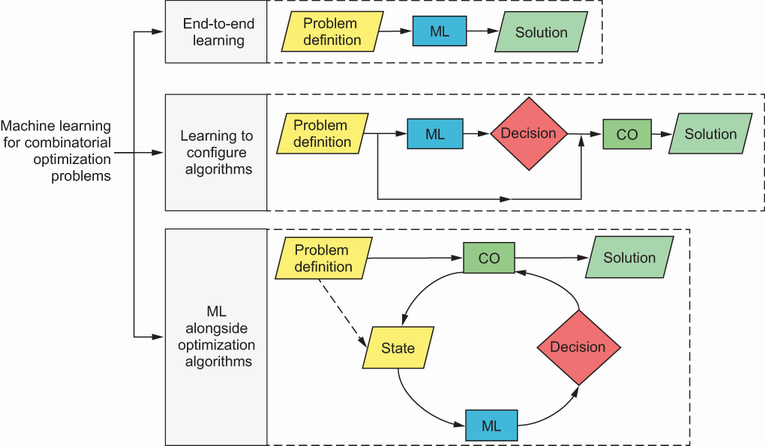
A visual map of the three ways machine learning can generate, configure, or guide combinatorial optimization. section 11.5
