A neuron is a nerve cell that transmits information through electrical impulses and chemical signals. Neurons connect the brain with the wider nervous system, helping the body sense, interpret, and respond to its surroundings. section 6.1.1
Neurons differ by role and contain three essential parts:
- Sensory neurons carry information from sensory organs such as the eyes and ears to the brain. section 6.1.1
- Motor neurons relay instructions from the brain to muscles, governing muscle activity. section 6.1.1
- Interneurons include the remaining neuron types and help communicate within neural systems. section 6.1.1
- The cell body contains the nucleus and controls cellular functions; the axon carries impulses away; dendrites form receiving extensions. section 6.1.1
From sensation to action
Information arriving through the eyes or ears can be carried by sensory neurons to the brain, which can then direct muscles through motor neurons. This division shows how neurons support both perception and physical response. section 6.1.1
Biological neurons should not be treated as interchangeable with artificial neural-network units. Despite the shared name, artificial intelligence does not reproduce the full chemical, biological, neurological, and psychological complexity of the human brain. section 9.3
Figure 6.1 Image of a typical neuron (courtesy of Wikimedia Commons, CC BY-SA 3.0)
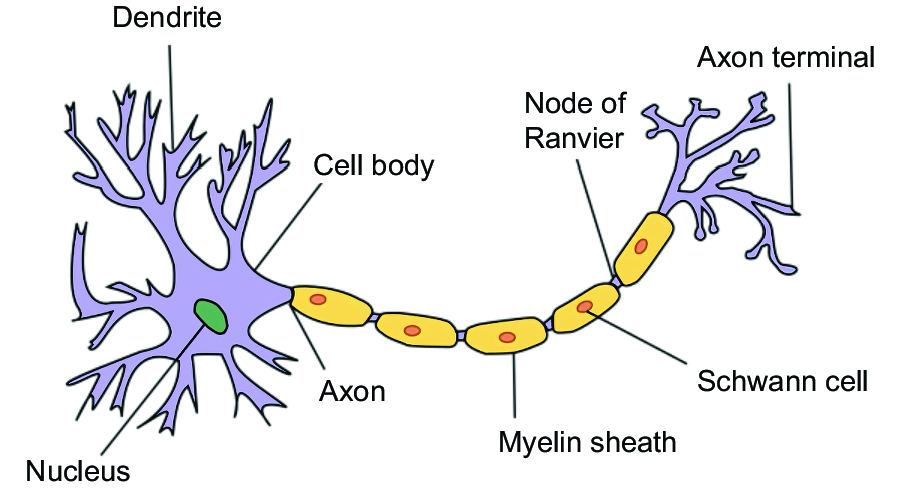
Use the labeled image to relate the cell body, axon, and dendrites to their roles in information transmission. section 6.1.1

