Natural language inference (NLI), also called Recognizing Textual Entailment, classifies the logical relationship between a premise and a hypothesis as entailment, contradiction, or neutral. It verifies whether evidence supports, refutes, or fails to determine a claim. section 5.1.1
Use NLI when a reference defines what is true, such as retrieved documents, databases, or records. In hallucination detection, treat evidence as the premise and a generated claim as the hypothesis. section 5.1.1 section 5.2.3
A practical NLI verification workflow is:
- Split generated responses or sampled responses into individual sentences or claims. section 5.2.3
- Compare each evidence sentence with the target claim using an NLI model. section 5.2.3
- Count entailments and contradictions: entailments reduce hallucination risk, while contradictions increase it. section 5.2.3
Catching a numerical contradiction
A semantic-similarity method may treat “revenue increased by 15%” and “revenue increased by 51%” as similar. NLI identifies them as contradictory claims, exposing the factual error. section 5.2.3
Table 5.2 Comparison of SelfCheckGPT variants
|
Variant
|
Accuracy
|
Cost
|
Latency
|
Best for
|
|
BERTScore
|
Moderate
|
Low
|
Fast
|
High-volume screening
|
|
NLI
|
Good
|
Low-Medium
|
Medium
|
Detecting contradictions
|
|
QA
|
Good
|
Medium
|
Medium
|
Fine-grained claim verifications
|
|
LLM-as-a-Judge
|
Highest
|
High
|
Slow
|
High-stakes evaluation
|
Compare NLI with BERTScore, question-answering verification, and LLM-as-a-Judge methods by accuracy, cost, latency, and intended use. section 5.2.3
Figure 5.2 A production hallucination detection pipeline. Generated responses are decomposed into claims, routed to the appropriate verifier, aggregated into response-level metrics, and converted into actions such as logging, review, regeneration, or blocking.
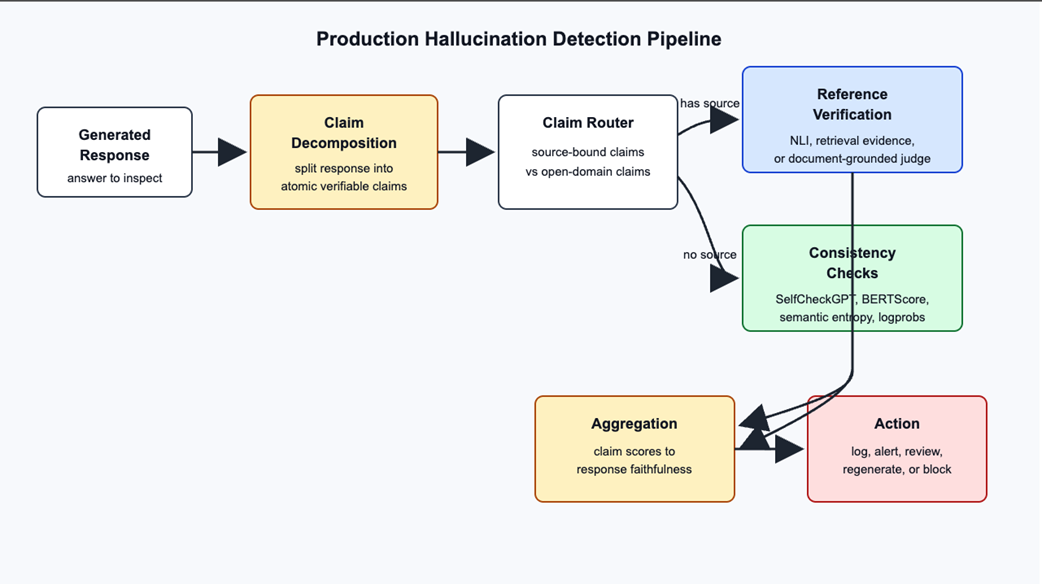
Trace how claim decomposition, verifier routing, metric aggregation, and operational actions fit into a production hallucination-detection pipeline. section 5.1.1

