A node-splitting operation transforms a causal DAG for an intervention by separating the target’s natural value from its imposed value. The original variable keeps its parents, while a new constant-valued node takes over its children. Downstream variables inherit intervention subscripts, making counterfactual quantities explicit within a single-world intervention graph (SWIG). section 10.7.3
Apply the transformation in three steps:
- Split each intervention target into a random variable retaining incoming edges and a constant intervention node retaining outgoing edges. section 10.7.3 section 11.6.1
- Append the intervention value as a subscript to every downstream variable. section 10.7.3
- Repeat the split for additional interventions, accumulating all upstream intervention subscripts. section 10.7.3
The resulting SWIG contains counterfactual variables and supports d-separation, enabling identification of suitable causal queries. Node-splitting can also represent level 3 queries whose factual conditions and hypothetical outcomes do not overlap, but this requires the single-world assumption: the natural value must remain knowable and unaffected by the intervention. section 10.7.3 section 10.7.5
Recommendation-policy intervention
For a recommendation policy T intervened from +t to −t, retain T with its profile parent C, create a constant intervention node −t for downstream variables, and represent outcomes such as W and A as W_T=−t and A_T=−t. Applying a second intervention to B adds B=−b to affected variables’ subscripts. section 10.7.3
Figure 11.13 The node-splitting transform splits the intervention target into a constant that keeps the children and a random variable that keeps the parents.
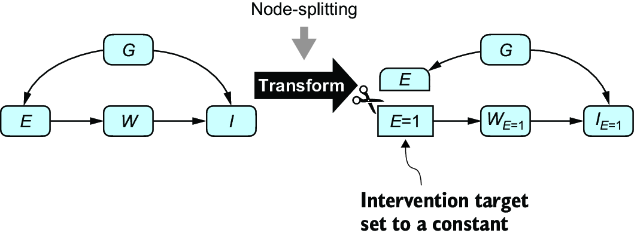
Shows the split between the constant intervention node that keeps children and the random variable that keeps parents. section 11.6.1
