A non-nullable variable has a type that cannot receive null. With null state analysis enabled, the compiler warns when code assigns null to such a variable or accesses a nullable value without checking it first. A string is non-nullable; string? permits either a string value or null. section 5.4
Choose the declaration that matches where null is allowed:
- Use string when the value must exist and callers should be able to use it without a null guard. section 5.4
- Use string? when null is a valid result; consumers should check before accessing its members. section 5.4
- Use required for a non-nullable property whose value must be supplied during object creation. section 5.4.1
- Use a default such as string.Empty when missing input should produce a consistent fallback instead of a build error. section 5.4.2
A Product model with enforced or defaulted names
public required string Name { get; set; }\n\nProduct kayak = new Product { Name = "Kayak" };\n\nOmitting Name from an object initializer produces a build error. If a fallback is preferable, declare the property as public string Name { get; set; } = string.Empty;. section 5.4.1 section 5.4.2
The question mark applies to the element, the container, or both. Product?[] allows null Product elements but requires a non-null array; Product[]? allows only non-null Products but permits a null array; Product?[]? allows both. section 5.4.3
Figure 5.2 A null state analysis warning
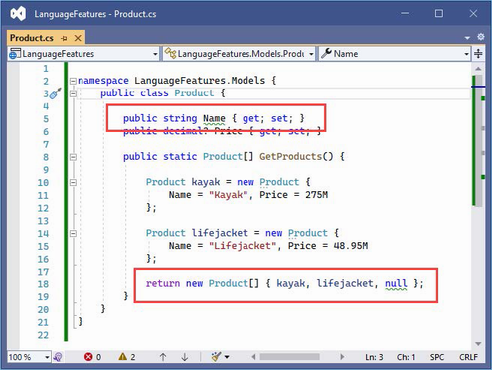
Use the warning visualization to identify assignments or member accesses that violate the declared null state. section 5.4

