A nonce is a value used to distinguish cryptographic operations. Its exact rules depend on the primitive: an authenticated-encryption nonce generally must not repeat, while an ECDSA signing nonce must be unique, secret, and unpredictable. The name alone is not a specification; follow the algorithm’s documented requirements. section 4.5.2 section 7.3.3
Nonce behavior changes with the construction:
- AES-GCM and AES-CTR use a nonce to help generate a keystream. AES-GCM commonly uses a 96-bit nonce that must be unique but need not be unpredictable. section 4.5.2
- ChaCha20-Poly1305 uses a 12-byte nonce with a counter. Reusing it can reveal the XOR of plaintexts, expose authentication material, and enable forged messages. section 4.5.3
- ECDSA calls its per-signature random value k a nonce or ephemeral key. Repeating or predicting k can recover the private key; RFC 6979 provides deterministic generation. section 7.3.3
- TLS 1.3 starts the authenticated-encryption nonce at a fixed value and increments it for each message, helping detect replay or reordering. section 9.2.2
- Bitcoin miners vary a block’s nonce to produce a hash satisfying the protocol’s target, treating it as a counter or random value. section 12.2.2
The dangerous repeat
Suppose two AES-GCM messages use the same key and nonce. Both produce the same keystream, so XORing their ciphertexts cancels that keystream and reveals the XOR of their plaintexts. In these schemes, nonce management is part of the security boundary, not a cosmetic field. section 4.5.2 section 4.5.3
When repetition is tolerated
AES-GCM-SIV is designed for nonce misuse resistance. Reusing a nonce with different plaintexts reveals less than reuse in AES-GCM or ChaCha20-Poly1305, although avoiding repetition remains preferable. section 4.6.2
Figure 4.13 The AES-CTR algorithm combining the AES cipher with the Counter mode of operation (CTR mode). A unique nonce is concatenated with a counter and encrypted to produce a keystream. The keystream is then XORed with the actual bytes of the plaintext.
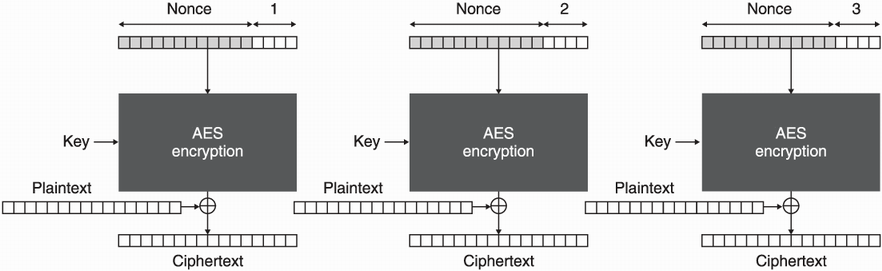
Trace how AES-CTR concatenates a unique nonce with a counter, encrypts the result into a keystream, and XORs it with plaintext. section 4.5.2
Figure 12.4 On https://andersbrownworth.com/blockchain/blockchain, one can interactively play with a toy blockchain. Each block includes its parent’s digest, and each block contains a random nonce that allows its digest to start with four 0s. Notice that this is true for the top blockchain, but the bottom one contains a block (number 2) that has been modified (its data was initially empty). As the modification changed the block’s digest, it is no longer authenticated by subsequent blocks.

Interact with a toy blockchain to see how changing a block’s nonce changes its digest and affects subsequent block references. section 12.2.2



